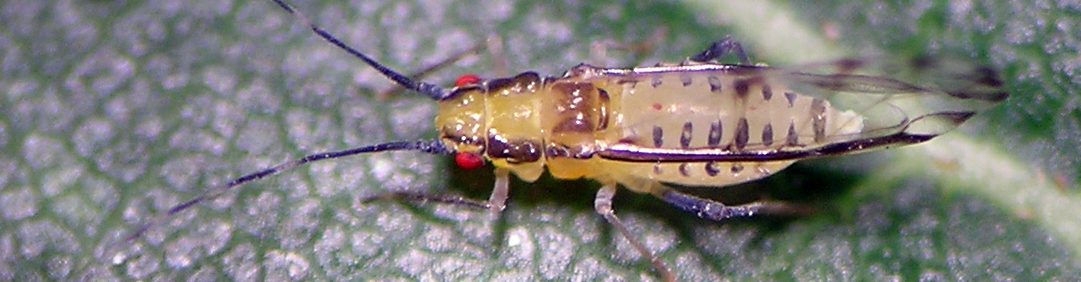
Cedoaphis incognita Hottes & Frison (1931) history and taxonomy
Andrew Jensen, Olathe, Colorado
March 2026
As I wrote about on my main Cedoaphis page, this ‘species’ has been quite an interesting challenge to unravel over the past 20+ years. On that page I cover the host use and life cycle of what is commonly known as C. incognita. Here I want to cover the history of the genus and the species in the older literature, discuss my sorting of specimens in 2026, and provide conclusions on taxonomy and future research on ecology, host use questions, etc.
The origin of the genus Cedoaphis is messy and suboptimal. Oestlund (1923) coined the genus name, placing what he considered to be Aphis symphoricarpi Thomas as its only species. However, looking at the text he provided and a key to 4 genera he thought were related makes me think he was looking at what we now call Cedoaphis incognita, not what we now call Aphthargelia symphoricarpi (Thomas). Features he mentioned that suggest this conclusion are the very large lateral tubercles (which he described as “glands”) and the rhinaria on the antennae being big with very wide margins. Hottes & Frison (1931) found type material of Thomas’ A. symphoricarpi and immediately concluded that it was what was then known as Aphis albipes Oestlund. This moved A. albipes into what would later become Aphthargelia as a synonym of Aphthargelia symphoricarpi (Thomas). As noted by Hottes & Frison, this left Oestlund’s conception of Cedoaphis symphoricarpi without a name. They therefore proposed the name incognita.
Practically speaking, then, the first description of C. incognita was in Oestlund (1887) under the name Aphis symphoricarpi Thomas. This is what he provided:
“Antennae a little shorter than the body; third and fourth joint much thickened, and sometimes almost united, with numerous irregular round or oblong sensoria; III 0.25 mm, IV 0.25 mm, V 0.22 mm, VI 0.12 mm, VII 0.3 mm. Beak long, 0.75 mm. Eyes dark brown. Wings with rather prominent blackish veins; stigma broad. Legs black, with only base of femur and tibia pale. Abdomen green, with marginal patches of black above the honey-tubes, and more or less transverse bands between the honey·tubes. Honey-tubes black, cylindrical, hardly twice the tarsi in length (0.25 mm). Style very short and blunt, concolorous with abdomen. Length of body 2.30mm; to tip of wings 3.50 mm.
Found on the leaves of Symphoricarpus vulgaris, at the end of branches, causing them to curl.”
It seems that all this text refers to alate viviparae. As usual with older papers like this, I hasten to note that Oestlund used old terms for morphology including referring to the ANT VI processus terminalis as ANT VII, siphunculi were called honey tubes, and the cauda was called the style. At least in this case he provided measurements in mm instead of inches as he sometimes did. The main clue in this description that he had C. incognita and not Aphthargelia is his mention of antennal segments III and IV being “much thickened, and sometimes almost united,” which is a common attribute of the spring alate viviparae of what has been called C. incognita. Another clue is that the wings had “rather prominent blackish veins.” So anyhow, by 1931 we had finally settled on the current genus and species, Cedoaphis incognita Hottes & Frison.
Now, let’s check what some other 20th century authors wrote about this species. Most of what I could find were listings of this species being identified from various places. Gillette & Palmer (1932) and then Palmer (1952) provided very similar descriptive text and biological information. Since Palmer was more thorough, let’s look at what she offered: there was descriptive text of what she thought were fundatrices, apterous, and alate viviparae (all apterae and alatae were from spring and early summer). Based on this text and her figures, she did not have fundatrices but rather small apterae – this is obvious from her illustration of the antennae, which shows 6 segments and a good cluster of rhinaria on ANT III. Fundatrices in all my collecting have strongly fused antennal segments, most often with 4 total plus a very short p.t. and no secondary rhinaria. The illustrations of the alata are in keeping with most of my material collected in the spring and early summer. The most important error or misunderstanding she promulgated was that this aphid overwinters below ground, with fundatrices occurring on the roots of Symphoricarpos. While it is of course possible that she found such a thing, all my collecting shows that fundatrices occur in galls composed of clusters of curled and discolored leaves. It is a bit odd that she made no mention of these leaf-curl galls, which are the home of aphids in spring, and throughout the summer and fall under some circumstances.
Next, we need to evaluate the junior synonym of this species, Aphis chipetae Hottes (1933). As was typical for him, Hottes provided a lengthy and detailed description that makes it very clear he was looking at what has been known as Cedoaphis incognita. His samples were found on crowns of Castilleja in mid-July at a location he called “Skyway” Colorado. Mr. Googly is not aware of such a location, but Palmer (1952) gives as a clue, stating that it is near Cameo; this clue suggests that Skyway may be referring to a trailhead on the Grand Mesa in Mesa County, just up the mountain from Cameo.
The two names, C. incognita and Aphis chipetae, seem to have remained unconnected until Eastop & Hille Ris Lambers (1976) and their smoke-filled room in which they made decisions that rearranged the taxonomy of the entire Aphididae, all without explanation or justification. They recognized that these two names were referring to identical or very similar species and chose to create the synonymy.
This summary brings us up to the time I started collecting aphids on Symphoricarpos everywhere I went as part of my efforts to understand Aphthargelia and Cedoaphis. My first sample of Cedoaphis was from May 1992 in eastern Oregon. Since then, I have amassed another 158 slides from all over western U.S.A.
Sorting these slides
Not long into collecting this genus regularly, I witnessed the extreme variability in their morphology, color in life, and habit on their Symphoricarpos hosts. Eventually I made the connection between C. incognita and Hottes’ species A. chipetae on Castilleja, resolving the mystery about the apparent host alternation that I had seen in the field. Although only one species name was available, I strongly suspected that more than one biological species was involved. Since about 2018 I have tried a couple times to sort these samples, each effort lasting a couple hours and ending in frustration caused mostly by extreme variability in color and some morphological features. Eventually I had gathered enough material to show that the spring and fall alatae have drastically different antennae and secondary rhinaria, which addressed some of my confusion, but other difficult points remained. Then in late February 2026 we had a snowstorm that kept me indoors for a few days with little to do. Although I was a bit tired of my aphid studies after researching and writing three long taxonomy essays already that winter, I decided to take one more stab at sorting Cedoaphis. Because I already knew about the strong differences between spring and fall alatae, I sorted the material in separate groups of spring (up to about 1 July) and fall (August and beyond) samples, starting with alatae, then apterae, then oviparae, then fundatrices. As it turned out, there were subtle but consistent differences that allowed splitting my 159 slides into 4 categories we’ll call species for simplicity’s sake.
Briefly, the characters that I found useful in my sorting were as follows.
Lengths of setae: over the years of looking at this genus I’d noticed variation in seta length on the abdomen, but I was confused about whether the differences I saw were useful in delimiting groups or species. When starting this sorting process, I noticed that setae length on the femora also clearly varied. It wasn’t long and I had seen that specimens could be fairly easily assigned to groups based on combinations of seta length on abdominal segments, R IV+V, and the femora.
Spinal tubercles on prothorax: I had seen large prothoracic spinal tubercles on some of my specimens over the years and assumed they were haphazardly present and were probably not useful taxonomically. However, close evaluation during this sorting process allowed carving off a large subset of specimens that are unified by both setae and these spinal tubercles.
Shape of the ANT VI Base: a subtle but fairly consistent feature is that one of my species has a more elongate and nearly cylindrical Base compared to others that have a Base that is narrow proximally and much inflated around the primary rhinaria.
Thickness of and rhinaria on ANT III and IV of alatae: this feature is not very useful in separating species but it is crucial for recognizing spring versus fall migrants. Spring migrants have very thick ANT III & IV that have a mix of small circular and large transversely oblong rhinaria. Fall (& late summer) migrants have ANT III & IV that are much thinner and that have mostly small circular rhinaria with no or much smaller transversely oblong rhinaria.
As usual in these essays, I feel compelled to mention some of the features I did not focus on or find useful. Measurements of various body parts were not attempted for a couple reasons: 1) time constraints – I don’t want to measure a few hundred specimens unless I have to; 2) my informal evaluation suggests that there is a lot of variation, a fair bit of developmental deformities, etc. that would complicate things. You’ll notice I say nothing about siphunculi above. This is because I see a lot of variation in length, shape, and imbrications that seems to have nothing to do with species categories, with substantial variation common between the siphunculi on a single specimen. Tarsi and caudas seem to be very uniform in shape, length, and setation, the latter very difficult to count on the cauda due to extremely dense and fine setae. Numbers of antennal rhinaria are frustratingly uniformly variable across species, this being especially true in the apterae, some specimens with almost no rhinaria on ANT III-V and others with dozens of them.
With that, here are the putative species sorted from my material.
Cedoaphis Species #1, short setae, no spinal tubercles
This species stands out in having setae extremely short on the abdominal dorsum and margin, the R IV+V, and the femora. All setae on the femora are short, including the ventral setae that are usually extra long in many Aphidinae. The femoral setae are also at an oblique angle, barely standing out from the cuticular surface. I have 57 slides, and have identified this species from all major Symphoricarpos species I knew how to recognize in Oregon (S. albus, S. mollis, and S. oreophilus) plus the Symphoricarpos species I most commonly deal with here in eastern Utah, Colorado, and New Mexico (which I don’t know how to identify to species in the field). I also have samples from various Castilleja species. My samples are from Washington, Oregon, California, Idaho, Utah, Colorado, and New Mexico.
Cedoaphis Species #2, short setae, spinal tubercles
This species has short setae as in Species #1 but it also has a pair of large spinal tubercles on the prothorax. This is the species I alluded to above with a Base of ANT VI that looks more cylindrical (less constricted at its base and less expanded around the primary rhinaria). This is the one species for which I lack fundatrices and sexuales. One worry in this regard is that these morphs of this species may lack the spinal tubercles present in regular apterae and alatae, resulting in those morphs being sorted to Species #1 In evaluating my fundatrices with short setae, a couple had strange cuticular irregularities on the prothorax that might be vestigial spinal tubercles. Almost all my 25 slides of this species were collected on what I thought was S. albus, the other identified species being S. oreophilus. I should note that my species identification of Symphoricarpos is poor to middling, as they say. I have 1 sample from Castilleja. My samples of this species are from Washington, Oregon, and Idaho.
Cedoaphis Species #3, medium-length setae
This species was, in retrospect, the cause of much of my confusion in previous efforts to sort my samples. The problem had been that I couldn’t tell whether the slight variation I saw in setal length was taxonomically relevant. Starting this sorting from scratch, however, allowed me to see a consistent group-defining pattern: this species has long setae on abdominal tergite VIII (long being about 2 or 3X length of anterior abdominal setae), slightly shorter setae on ABD VII, then short setae as in Species #1 and #2 on remainder of abdomen; plus it has femoral setae noticeably longer and slightly less recumbent, usually with at least 1 quite long and upright ventral seta; finally, it usually has one pair of long accessory setae on the R IV+V that are mixed with short setae typical of Species #1 and #2. I have 46 slides sorted to this species most of which were living on what I called S. oreophilus, unidentified Symphoricarpos, and various Castilleja. My samples are from Oregon, California, Idaho, Nevada, Utah, Wyoming, and Colorado.
Cedoaphis Species #4, long setae
As the name suggests, this species has much longer setae on the abdomen, femora, and R IV+V than the others. This difference is obvious. The femoral setae are also much less recumbent, some standing almost at right angles to the cuticle. My 30 slides of this species were collected on various identified and unidentified Symphoricarpos species and include 3 samples from Castilleja. These samples were found in Oregon, California, Idaho, Nevada, Colorado, and New Mexico.
Mixed samples
I must confess that about 20 of my slides have what appear to be 2 species on them (recall from elsewhere on my website that I usually mount 2 or more specimens per slide). It is especially common to have both Species #3 and #4 on the same slides. Two obvious reasons can be proposed for this fact: 1) there are not in fact 2 species involved, or 2) these 2 species often co-occur in the same localities and/or in the same leaf galls. As can be guessed by my separation of Species #3 and #4 above, I lean toward the second option. First of all, the differences in setae length and shape really are substantial in the scheme of taxonomic characters. Second, I have seen differences in appearance and habit in the field that have suggested more than 1 species in some localities. Detailed field studies would be very interesting. For example, one might found colonies of known species on the same shrub then observe movement of aphids between galls. Or, one might create mixtures of overwintering eggs on single branch tips and see what the hatchlings do. It might also be interesting to experiment with fall alatae and males to see whether they prefer to segregate by species or to gather. I should note that I commonly see aphids of many different genera and species gathering together to form mixed colonies, whether rapidly growing aggregations of apterae, or immigrating alatae and males clumping together on a leaf in the fall.

Do we know what Cedoaphis incognita is?
Short answer: No. The main reason is that we have not seen the original material described by Oestlund in 1886. From among these specimens a lectotype should be selected (Smith & Parron 1978 indicate Oestlund’s material are “cotypes”) and my material compared to it. Second, Oestlund’s material was from Minnesota and was almost certainly living on a species of Symphoricarpos I have never collected from. Plus, the ecosystems of Minnesota and neighboring midwestern states are quite different from most habitats represented in my collection. I would not be surprised to find that Cedoaphis in Minnesota, and therefore Oestlund’s species, are not conspecific with any of my 4.
Additional research needs
Apart from the host-related experiments I suggested above, and the geographical expansion of field work to include the Midwest, other research directions could be interesting. For example, I wonder if a taxonomy based on oviparae and/or males could be possible; I saw interesting variation in the oviparae that I did not attempt to cover in this essay. As I usually note in these essays, it is possible that some morphometric analyses could be fruitful, although my hunch is that within-specimen and within-species variation combined with between-species constancy are so strong that morphometrics will struggle to be helpful. As usual it is possible that some kind of DNA analyses could help understand species-level taxonomy and ecology, but I’m unclear on what that could provide other than a vague sense of confirmation of results gained from detailed observation and experimentation in the field. It seems like DNA might also be useful in the reverse order, i.e. it could be used to generate hypotheses to be tested using those detailed field observations and experimentation.
References cited
Eastop, V.F. & Hille Ris Lambers, D. (1976) Survey of the World’s Aphids. Dr. W. Junk, The Hague, 573 pp.
Gillette, C.P. & Palmer, M.A. (1932) The Aphidae of Colorado. Part II. Annals of the Entomological Society of America, 25(2), 369–496.
Hottes, F.C. (1933) Descriptions of Aphiidae from western Colorado. Proceedings of the Biological Society of Washington, 46, 1–23.
Hottes, F.C. & Frison, T.H. (1931) The plant lice, or Aphiidae, of Illinois. Bulletin of the Illinois Natural History Survey, 19, 121–447.
Oestlund, O.W. (1923) A synoptical key to the Aphididae of Minnesota. Report of the State Entomologist of Minnesota, 19, 114–151.
Palmer, M.A. (1952) Aphids of the Rocky Mountain Region. The Thomas Say Foundation, 5, 452 pp.


