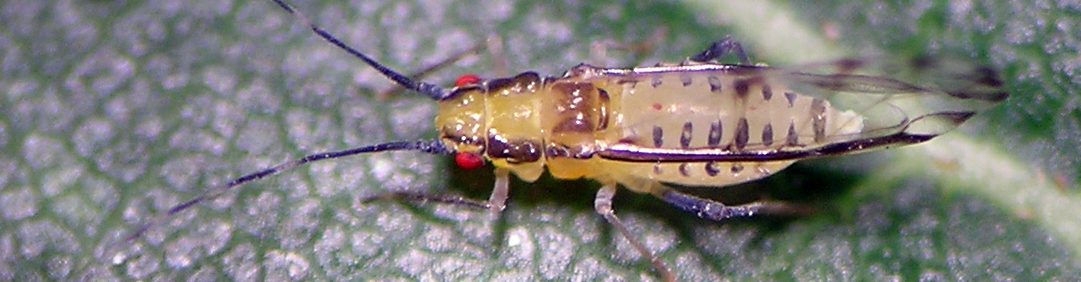
An Informal Review of Epameibaphis Oestlund, 1923
Andrew Jensen, Olathe, Colorado
March 2026
Sagebrush aphids were among the first that I collected way back in the late 1980s when I was an undergraduate entomology student in Oregon. The number of species that use sagebrushes is tremendous. Epameibaphis is one of several genera involved. Like my work on Obtusicauda, the purpose of this essay is to summarize what I know about the genus, what I have in my collection, how that all compares to historical information in the literature, and to write a key to putative species. The latter is meant mostly for my own use so that I can quickly and easily sort incoming samples rather than saving them up all year until winter then work through them and try to remember how and why I had sorted my previous samples the way I did. I began this project by re-examining my previous sorting attempts of my 338 slides of this genus, then sorting my 2025 samples into those categories, which hence forth I will refer to as ‘species’ for the sake of simplicity.
Epameibaphis was coined by O.W. Oestlund in 1923 for his species E. frigidae described in 1886. The name first appeared in his list and discussion of aphid classification as he then understood it. He provided no description or diagnostic notes of the genus, merely referring readers to the single species then known, E. frigidae. Interestingly, this name came immediately after Cachryphora, another new genus name in this paper, and probably the most similar genus to Epameibaphis morphologically. My brief diagnosis of the genus might read like this: Macrosiphini with acute, needle-tipped rostrum typical for sagebrush feeding aphids, head without antennal tubercles, dorsal setae usually a bit broad with a flared tip, head usually with 4 pairs of posterior discal setae, siphunculi cylindrical but with an apical bulb-like swelling, and cauda short with a rounded tip and usually 5 but up to about 8 setae. There are currently 3 species recognized as valid as follows:
Epameibaphis atricornis Gillette & Palmer, 1933
Epameibaphis frigidae (Oestlund, 1886)
— Epameibaphis thornleyi Knowlton, 1946
Epameibaphis utahensis Knowlton & Smith, 1936
Features (“characters”) useful in my sorting
This is another genus, like Obtusicauda, the species of which are frustratingly similar considering the normal taxonomic features in many other Macrosiphini. For example, tarsi are essentially the same across species, setation of the R IV+V is constant, setation of the cauda is almost constant and apparently not usefully varying between species, density of dorsal setae varies little or not at all (I’ve not done a thorough analysis), spinal and marginal tubercles do not occur, spinulation or other ornamentation of the head is absent, and numbers of setae on first tarsal segments are stable at 3.
Another form of difficulty in this genus, and Pseudoepameibaphis, is that the morphology and pigmentation of each species varies quite a lot through the season. I think it likely that if an aphid taxonomist naïve to these genera were to evaluate samples of the same species from early spring and mid-summer they would want to say they are not conspecific. Early spring forms have broad heads and often much darker pigmentation. Most species gradually become narrower in both head and body as each generation of the season comes and goes, only to become broader again in the fall. In a similar fashion, the degree of pigmentation often decreases through the summer and then increases again in the fall, especially when including pigmentation of oviparae, which can differ radically from viviparous generations. Length of antennal segments can also change a lot through the year.
The fundatrices of this genus also do not conform to common rules of variation from subsequent generations. Most Macrosiphini fundatrices can be recognized by shorter than normal antennae, especially the processus terminalis (p.t.), and by apical setae on the hind tibiae being notably longer than apical setae on the other tibiae. Epameibaphis does not follow these rules. Instead, fundatrices tend to be a little larger than other viviparae, more darkly pigmented, and to have the widest heads. After looking through my 338 slides, I was getting fairly good at guessing which month the sample was from based on head shape alone.
So, all that said, here are the few features that I find useful in taxonomy of Epameibaphis.
Siphunculi shape: these vary across species in terms of being clavate or not basad of the apical bulb, how thick they are overall, and how strongly imbricated.
Siphunculi pigmentation: variation from pale to dark brown, which seems to be fairly stable among all apterous viviparous generations of a species.
Length of R IV+V: absolute length seems to be quite stable within species even as the rest of the morphology changes through the growing season. Distinctions among species are subtle.
Shape of dorsal setae: variation in terms of length, breadth, and degree of apical flare.
Length of setae on antennae: these seem to fall into 2 broad categories of short versus long. The latter are about as long as the basal width of ANT III, while the former are about half that length or shorter.
Pigmentation of legs: while this feature varies a lot across the season, there are still useful differences between similar species.
Pigmentation of antennae: another variable feature that might occasionally be useful.
You’ll notice that, as in my Obtusicauda work, I did not try to evaluate morphometrics of the various body parts. There might be something there, but I think the seasonal variation would be problematic – one might need to do morphometric comparisons only between samples of the same generation.
Sorting My Slides and Published Species Discussion
In this essay I want to try an abbreviated analysis compared to what I did with Obtusicauda and Wahlgreniella. Rather than cover my sorted groups, then the taxonomic history, then a summary of what I think my species might be, the small number of described species in Epameibaphis allows me to combine things in one treatment. Several hours of work led me to the following categories, which, like I said above, we’ll call species for the sake of simplicity. The first two are confidently identified species due to their distinctive features. The other six will be listed as numbers, Species #1 through Species #6, one of these including the history of a described species that it probably represents.
Epameibaphis atricornis Gillette & Palmer
This species was described by Gillette & Palmer in 1933. They described all morphs except the fundatrix based on 1 alata and “numerous” apterae all taken on 12 September 1932 at Chimney Rock in Larimer County, Colorado (west-northwest of Fort Collins). Their reported host plant was Artemisia longifolia, but this was almost certainly a misidentification of Artemisia cana. The latter species is far more common than the former, but confusion remains because Larimer County is one of two Colorado counties with known populations of A. longifolia. Their oviparae and alate males were reared in the lab from this same collection, specimens being obtained for preservation on 21 October 1932. Their descriptions are lengthy and provide adequate information and illustrations to make recognition of the species easy.
Because of its dark siphunculi and appendages and consistent appearance of the siphunculi, this species is easy to recognize, based on its original description, across many sagebrush host species and geographical areas. When starting my sorting work I was concerned that there may be two or more species confused under this name that share similar pigmentation patterns, but I was not able to determine such a thing. Like other species of the genus, its pigmentation varies quite a lot through the season but certain features are consistent. It is very common, being by far the most-collected species of this genus; I have 117 slides. Samples are from Washington, Oregon, California, Idaho, Nevada, Utah, Colorado, New Mexico, and North Dakota. Host plants include most of the sagebrush species I’ve ever seen: A. arbuscula, A. bigelovii, A. californica, A. cana, A. filifolia, A. nova, A. tridentata (all 4 forms), and A. tripartita. Useful features in recognizing this species include:
- Siphunculi thick, dark, strongly imbricated from base to a small smooth area immediately basad of the apical bulb-like swelling.
- Femora and tibiae dark, with fore femora noticeably paler
- Dorsal setae long, thin, with barely flared tips
- Antennal setae of mixed length, but a good fraction are longer than basal width of ANT III
Other aspects of pigmentation vary a lot, such as the tergum, which can be anything from dark brown to colorless, and the cauda, which varies from pale to medium brown. Males are alate.


Epameibaphis frigidae (Oestlund)
— Epameibaphis thornleyi Knowlton, 1946
Oestlund (1886) described this species based on material collected in Minnesota, presumably near Minneapolis. We are not told when they were collected, but at least we know the host plant: Artemisia frigida. He only had apterae and oviparae, which were combined in one description titled “Wingless form.” His description was his typical style: long fun-to-read text that doesn’t provide much useful information by modern standards. It is important to note that his few measurements in this paper are in inches (body length 0.05 to 0.06”). Oestlund’s text paints a nice picture of the appearance in life of this aphid and confirms the typical shape of the head and siphunculi. Following his description, there seems to have been quite a lot of misidentifications of this species collected from other species of sagebrush such as A. tridentata and A. californica. As far as I can see the next paper that mentions it living on A. frigida and provides any taxonomic information was Knowlton & Smith (1936). Here they mention the rhinarium on ANT III of their apterae. Palmer (1952) then shows 1-4 rhinaria on ANT III of apterae, and she figures the very long R IV+V. Both papers are based entirely on material collected in Colorado, Utah, and Idaho. It is hard to tell if anyone confirmed their species identifications by looking at Oestlund’s type material (which, I admit, can be hard to find and confusing to study due to his eclectic writing and slide labeling style). So, we are basically going on faith that the populations around Minneapolis and those in the Rocky Mountain Region are the same species. The synonym of this species, E. thornleyi, was described from A. frigidae based on material found in Wyoming, supposedly feeding on A. tridentata. This host is possible but given Knowlton’s common misidentification and misattribution of hosts, one can’t be sure. In any event, the features they provide us for E. thornleyi do indeed point very strongly to this synonymy being correct.
This species is also easy to recognize due to its apparent host specificity on Artemisia frigida, and because of a couple morphological features. It is very common, occurring at some level in most of the stands of A. frigida I find. Within my 41 slides of this species, I have a few samples from other species, A. tridentata and A. bigelovii, but these were sites with a mixed stand that included A. frigida. My assumption is that rain or other disturbance caused the aphids to settle on a non-typical host plant. My samples are from mid-elevation desert sites (~1,200 – 1,500 meters) up to high mountain slopes well above 3,000 meters. States represented: Washington, Oregon, Wyoming, Utah, Colorado, Arizona, and New Mexico. Useful features in recognizing this species include:
- Pale legs and body
- R IV+V very long – it seems like A. frigida somehow causes development of long R IV+V in its host-specific aphids
- ANT III in apterae with 1 to a few rhinaria
- Siphunculi pale, long and thin with strong apical bulb
Not a lot of features are required to recognize this species mostly due its very long R IV+V and presence of rhinaria on ANT III in apterae. Males are alate.


Epameibaphis Species #1, clavate siphunculi on A. arbuscula
This is my third-most collected species (58 slides), which I discovered while living in south-central Oregon where its host, A. arbuscula, is common. It immediately stands out as distinct from the previously described species because of its strongly clavate siphunculi basad to the apical knob. Most of my collections are from the valleys and forests near where we lived in Oregon, but I also have samples from California, Idaho, Nevada, Utah, and Colorado. Specimens from Utah and Colorado differ from the others by having noticeably less-clavate siphunculi. This may be related to the disparate geographies or perhaps that A. arbuscula is a complex taxon, these eastern samples possibly having been on a different subspecies (variety?) of the plant. I have all morphs, although only 1 alata has been found. Because of its unique siphunculi, only that feature is necessary for recognition among all my samples. That said, it is usually more or less pale, and has a “short” R IV+V. Most males are alate, although I have 1 apterous male from southern Oregon.


I did not attempt to photograph a mid-summer aptera because they are so pale that my equipment will not produce anything useful.
Epameibaphis Species #2, small, short antennae
This is my fourth-most collected species, with 34 slides. For some time I wrestled with whether this one or Species #3 below might be E. utahensis, but I ended up leaning toward Species #3 on this question. Species #2 is the smallest of those in my collection, with remarkably short antennal segments in mid-season specimens, much as in Pseudoepameibaphis essigi Knowlton & Smith. My samples were found on Artemisia nova and A. tridentata (mostly on the form I call parishii) in western Colorado except for one sample from Angel Peak in northern New Mexico. This species is similar to Species #3 below, both being almost entirely pale with cylindrical or very slightly clavate siphunculi, and dorsal setae being relatively short and broad. Points of difference are the shorter R IV+V and shorter ANT III setae in Species #2 compared to Species #3. Useful features in recognizing this species include:
- Small body size overall
- Almost entirely pale except tarsi and ANT VI
- Short antennal segments except p.t. that sometimes looks long, antennae shortest in mid- to late-summer specimens
- Setae on antennae markedly shorter than basal width of ANT III
- R IV+V fairly short, about 0.11 mm
- Dorsal abdominal setae relatively short and broad, with tip flared
I have no males of this species.


Epameibaphis utahensis? Knowlton& Smith, 1936; Species #3
Although I cannot be sure whether my Species #3 (17 slides) is the same as Knowlton & Smith’s (1936) species E. utahensis, it seems likely so I am covering both under this header.
Knowlton & Smith (1936) described this species based on an undisclosed number of apterae, alatae, and oviparae collected from unclear location(s) across much of northern Utah in spring (viviparae) and October (oviparae). To be clear, we are given several locations in Utah where specimens were collected, but we are not told which locations (some? all?) were the source of specimens used in making the description. They report hosts as being “Artemisia, the usual species being tridentata,” which is not terribly helpful. Were there other species of Artemisia involved? If so, why not mention them or keep track? The description delivers the usual measurements and a few counts, most of which are not very useful in Epameibaphis taxonomy, but there is still useful information. For example, they report R IV+V length to be 0.14 – 0.16 mm, pigmentation was overall pale, but sometimes apical parts of siphunculi and antennae were dusky. Their illustrations suggest that setae on ANT III are longer than Species #2, about equal to the basal diameter of ANT III. A later useful treatment of this species was Palmer (1952). She reported this species as living throughout Utah and she had a collection each from Wyoming and Colorado. Host plants she listed were A. filifolia, A. tridentata, and A. vulgaris. The first two make sense and conform to my samples; A. vulgaris makes little sense because according to the Flora of Colorado (Ackerfield, 2015) it does not occur in the state and I question whether it occurs in Utah or Wyoming. I’ve seen other references to this plant by Gillette, Palmer, and Knowlton but I wonder what plant they were actually looking at? Palmer’s illustration does an even better job of portraying the antennal setae as being relatively long, about equal to the basal width of ANT III.
My samples of this species are from Washington, Oregon, Nevada, Colorado, and New Mexico (a little ironic that none of them are from Utah?) collected on A. arbuscula, A. cana, A. filifolia, A. spinescens, and A. tridentata (at least 2 of the forms). Sites were mostly mid-elevation and dry. Useful features in recognizing this species include:
- Body and appendages mostly pale except apical part of ANT V and all of ANT VI, tips of siphunculi sometimes dusky, tarsi brown
- Siphunculi cylindrical and notably thick
- R IV+V a bit long, about 0.13 mm
- Dorsal setae moderately long, wide, with flared tips
- At least some setae on antennae about as long as basal width of ANT III
According to previous workers, the males of E. utahensis are alate. I hasten to note that one of my samples from outside Albuquerque, New Mexico living on A. filifolia features specimens that have dusky dorsa and light brown siphunculi. I consider these to be darker due to the late September collection date, but I could be wrong.

Epameibaphis Species #4, from central Washington deserts
During previous sorting efforts, I had created this group of 11 slides but marked on my little note card with the slides that they might be pale E. atricornis. Looking at them again, after looking at all my slides of E. atricornis, I was convinced they represent a separate species. Interestingly, all these samples are from central Washington near where I lived for 12 years in the greater Grant and Adams Counties at low elevation (~300 meters) in the driest deserts of the state. My samples were collected on A. rigida and A. tridentata (I did not know the different types back then). Useful features in recognizing this species include:
- Siphunculi thick and brown to more or less pale, imbricated and shaped much like E. atricornis
- Femora pale, tibiae brown
- Dorsum pale
- Antennae brown beyond apical 1/3 of ANT III, in contrast to pale femora
- Dorsal setae slightly broader than E. atricornis
- R IV+V rather long, ~0.15 mm
I have not yet seen any sexuales of this species.

Epameibaphis Species #5, very thin siphunculi on A. tridentata
When this month’s sorting process began I had previously created one category for specimens with very thin siphunculi. However, upon looking through all of them again I found that specimens collected from A. tridentata versus those from other sagebrush species could be consistently separated morphologically. I have 19 slides of this species collected in Nevada, Utah, Colorado, and New Mexico. All were feeding on A. tridentata, most in moderately dry mid-elevation slopes. Useful features in recognizing this species include:
- Siphunculi very thin (~ ½ as wide as other species) with small apical knob
- Siphunculi dusky to dark brown
- Dorsal setae long, thin, and nearly pointed
- Some setae on antennae longer than basal width of ANT III
- R IV+V relatively long, about 0.13 mm
- Legs dark to mostly pale, but tibiae always darker at base
- Antennae mostly pigmented from tip of ANT III
Males are alate.


Epameibaphis Species #6, very thin siphunculi on miscellaneous Artemisia
As just mentioned, this species is very similar to Species #5. I couldn’t help but notice that specimens with very thin siphunculi on Artemisia not tridentata all had the longer R IV+V. Most of the samples are from A. arbuscula, although I have a couple that I marked as A. nova (the two sagebrushes are very similar in overall appearance) and one as A. tripartita. My samples are from Idaho, Nevada, Utah, Colorado, and New Mexico. As far as recognition goes, this species is more or less the same as Species #5 except the R IV+V is consistently shorter, about 0.11 mm and the legs trend toward being more darkly pigmented. Males are alate.


It is worth noting that I have a sample that looks like, but a little different from, Species #5 or #6 but it was collected on what I considered to be the mountain sagebrush type of A. tridentata. More samples may point toward a third species in this group with very narrow siphunculi.
Needs for additional research.
Much as was the case for Obtusicauda, collecting outside my usual range of travel will be important to fully document and understand this genus. This is made clear by some of the discoveries that I made at each location I’ve lived: Species #4 while living in summer-dry deserts of central Washington, Species #1 while living in the high-elevation valley near Lakeview, Oregon, and species #2 while living in the winter-dry deserts of western Colorado. In addition to geographical variation, such broader work captures different sagebrush species, such as the addition of A. arbuscula while I lived in Oregon and A. nova since moving to Colorado. There are as-yet poorly explored sagebrush species and subspecies scattered all over the west. For example, the U.S. states of Montana, Wyoming, Nebraska, the Dakotas, eastern Colorado, Oklahoma, Texas, New Mexico, Arizona, and California plus Canadian provinces such as British Columbia and Alberta need much more attention.
As with most aphid genera, rearing and host transfer experiments could be very interesting. For example, I hypothesize above that some of these species are oligophagous across several species of sagebrush while others appear to be roughly species-specific. It would be useful to attempt rearing host-specific aphids on a range of sagebrush species to see 1) whether they can survive and reproduce on those plants and 2) whether their morphology is stable after such host switches (assuming they are successful).
As with all my analyses for my own use and for the website, morphometric analyses might be useful. They would require samples from across the growing season and probably will require within-species analyses across the season and between-species analyses within season stages and across seasons.
The oviparae of Epameibaphis are morphologically quite different from apterae. Features useful in separating apterae may often fail to separate oviparae. In fact a separate taxonomy of the species based on oviparae might be possible and would be very interesting.
Key to Species
As usual, this key is based on apterous viviparae, with focus on typical specimens one might find in late spring or early summer.
1. ANT III with 1 to a few rhinaria … Epameibaphis frigidae
— ANT III without rhinaria … 2
2. Siphunculi strongly clavate; mostly pale species living on Artemisia arbuscula … Epameibaphis Species #1
— Siphunculi tapering, cylindrical, or very slightly clavate; various pigmentation on various sagebrush species … 3
3. Siphunculi very thin with small apical expansion that is hardly a “bulb” … 4
— Siphunculi thicker, with very bulb-like apical bulb … 5
4. R IV+V about 0.13 mm long; living on A. tridentata … Epameibaphis Species #5
— R IV+V about 0.11 mm long; on various sagebrush species other than A. tridentata … Epameibaphis Species #6
5. Siphunculi medium brown to back-ish … 6
— Siphunculi pale to slightly dusky … 7
6. Femora brown, fore femora noticeably paler … Epameibaphis atricornis
— Femora pale to slightly dusky … Epameibaphis Species #4
7. Antennae with some setae about as long as basal width of ANT III; R IV+V about 0.13 mm … Epameibaphis utahensis? Species #3
— Antennae with setae much shorter than basal width of ANT III; R IV+V about 0.11 mm … Epameibaphis Species #2
References Cited
Ackerfield, J. (2015) Flora of Colorado. BRIT Press, Fort Worth. 820 pp.
Gillette, C.P. & Palmer, M.A. (1933) New species of aphids from Colorado. Annals of the Entomological Society of America, 26(2), 348–376.
Knowlton, G.F. (1946) A new sagebrush aphid (Homoptera). Entomological News, 57(6), 153–155.
Knowlton, G.F. & Smith, C.F. (1936) The genus Epameibaphis in Utah. Proceedings of the Entomological Society of Washington, 38(5), 89–92.
Oestlund, O.W. (1886) List of the Aphididae of Minnesota with descriptions of some new species. Annual Report of the Minnesota State Geological and Natural History Survey, 14, 17–56.
Oestlund, O.W. (1923) A synoptical key to the Aphididae of Minnesota. Report of the State Entomologist of Minnesota, 19, 114–151.
Palmer, M.A. (1952) Aphids of the Rocky Mountain Region. The Thomas Say Foundation, 5, 452 pp.