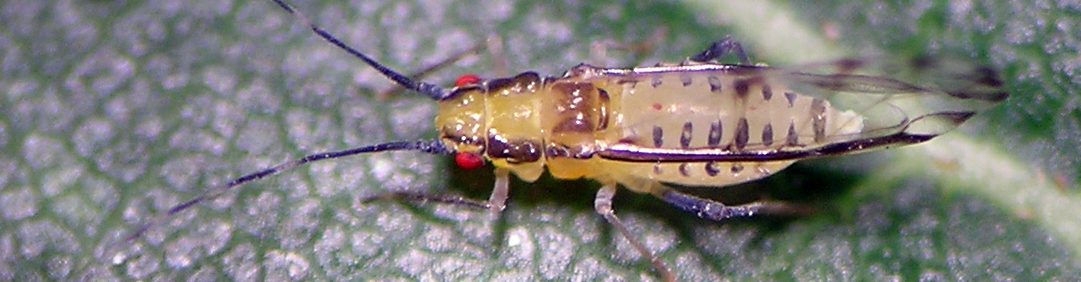
Obtusicauda Chaos in Western U.S.A.
Andrew Jensen, Olathe, Colorado
January 2026
Obtusicauda is one of the most common and obvious aphid genera in the sagebrush steppe of western U.S.A. from near sea level to high mountain slopes where its species feed exclusively on woody Artemisia commonly known as sagebrush (sometimes divided to include “Serephidium” for some of the species). The aphids are medium-sized to relatively large, often dark colored (in contrast to the host plant tissue), and can be very abundant across suitable landscapes. The genus was described by Soliman in 1927 with O. essigi as type, that species now considered to be a synonym of O. coweni. There are 6 North American species currently recognized as valid, with a complex nomenclatural history that includes an additional 7 species names now considered to be synonyms of the 6 recognized species. The current arrangement of valid versus synonymous names was established by Robinson and Halbert (1989) in their “review” of the genus in combination with opinions of previous authors such as Palmer (1952).
- Obtusicauda anomella (Knowlton & Allen, 1938)
- Obtusicauda artemisiphila (Knowlton & Allen, 1938)
- Obtusicauda coweni (Hunter, 1901)
a. Obtusicauda essigi Soliman, 1927
b. Macrosiphum jonesi Gillette & Palmer, 1928
c. Mucrotrichaphis albicornus Knowlton & Allen, 1940
d. Mucrotrichaphis flavila Knowlton & Allen, 1940 - Obtusicauda filifoliae (Gillette & Palmer, 1928)
a. Macrosiphum cefsmithi Knowlton & Allen, 1938
b. Mucrotrichaphis zerohypsi Knowlton & Allen, 1940 - Obtusicauda frigidae (Oestlund, 1886)
- Obtusicauda zerothermum Knowlton & Allen, 1938
a. Mucrotrichaphis toti Knowlton & Allen, 1940
Robinson and Halbert (1989) is an eclectic paper with an odd mix of information. Most of the paper focused on the nomenclatural history of the genus and its many named species. Another big chunk was discussion of the material they borrowed from collections across the continent, the condition of the slides, the clearing and remounting of the specimens, and the previous literature on the genus and its species. There is some general discussion of the characters believed to be useful in the taxonomy of the genus. The paper, however, lacks crucial information. For example, the authors briefly mention that they conducted rearing experiments of “2 or 3 species” but they give basically no results from this work, merely stating that it could be a useful approach. Then in the species accounts they provided almost no information about the taxonomy of the species, instead focusing on the specimens they examined, whether they were remounted, etc. For example, in the discussion of O. filifoliae the authors gave details of the examined slides and specimens of O. filifoliae, O. cefsmithi, and O. zerohypsi. They then declared all three to be synonyms but gave almost no information about the taxonomic features and analysis that led them to this conclusion. Another example is the coverage of O. artemisiphila, in which the authors tell us a little about the specimens they examined, but only mention where the slides were housed, not where and when the specimens were collected, what their host plants were, etc. Then they conclude that O. artemisiphila “appears to be a good species because of the short siphunculi and few secondary sensoria on antennal segment III of alatae, compared with O. filifoliae.” To find out the details of these features, we must refer to the key to species provided earlier in the paper. We still don’t know for sure how many specimens were measured, nor where they were found, etc. The only details we are given about collection records are the states from which they had seen specimens and a general statement about the host plant(s) of the species. The only taxonomy we are provided is the very brief key to species. In summary, I think this paper did a good job of cleaning up the species-level nomenclature of the group (assuming their decisions can be relied upon) but gave us almost no help with the taxonomy of the 6 species they considered to be valid. So, there is enormous need for a taxonomic analysis of the genus.
Alas, this essay cannot be a complete analysis of the genus. Doing that would require access to all types of all nominal species plus all Obtusicauda housed in aphid collections across the world. Instead, it will summarize the Obtusicauda I have collected (367 slides), comparing my sorted categories to named species, Robinson & Halbert’s paper, and previous authors’ work as well. I will finish by discussing the current state of Obtusicauda understanding, with suggestions on how to better understand the group.
The sorting process for all those slides
Over the years I have made various efforts to sort my Obtusicauda slides into species (or similar categories). For this essay I did a complete evaluation of my previous sorting and then sorted my 2025 samples into those categories created using previous decades’ samples. This means I have examined most of these slides 3 or more times over the past few years in my efforts to create these categories. That said, the distinctions among them can be subtle and categories encompass quite a lot of variability. If we think of my 367 slides as an unsorted mass at the start, I was very pleased to arrive at the end with only 44 slides in the “miscellaneous” category or unidentified due to containing isolated alate females or sexuales (my taxonomy is so far based mostly on the apterae).
Features (“characters”) useful in my sorting
I prefer the term “feature” for the morphological tidbits that I use to separate and unify my species categories. To me the term “character” implies more certainty than I feel that a certain characteristic is diagnostic for a species. Since I don’t know what constitutes a species in this genus, and can only sort things into broadly similar categories, the term “feature” feels better and less formal. That said, here are the features I found useful followed by some discussion of features I ignore or consider to be unhelpful in this genus.
- Color of coxae. This feature was noted by Robinson & Halbert (1989) and heavily relied upon in their key. My sense is that it is indeed useful and consistent for some species but there are more tweeners than they knew or acknowledged.
- Color of tibiae and femora. Degree of pigmentation of these two leg segments is correlated, with dark femora often accompanied by dark tibiae. But there are exceptions that are worth noting and thinking about. In contrast to the coxae, the darkest tibia is always the front one (unless they are all equally dark), while the darkest femur is the rear one.
- ANT III pigmentation. Most of the species covered here have fairly consistent degrees of pigmentation of ANT III. The base is always pale, the apex dark. The differences arise in how much of the segment is pale basad of that apical dark bit.
- Rough numbers and distribution of secondary rhinaria on ANT III and IV in apterous and alate viviparae.
- Length, and number of setae on, siphunculi. I did not measure the siphunculi in my specimens, but the species can be fairly easily separated into those with “long” versus “short” siphunculi. The former are typically about 1.75-2 times the cauda, while the latter are about equal to, or slightly longer or shorter than, the cauda. Numbers of setae on the siphunculi varies a lot within species but there are still useful trends, such as in species 7 and 8 below that almost lack them.
- Length of R IV+V in comparison to HT II. The R IV+V of this genus is typical of Artemisia-feeding aphids, being very acutely pointed with a needle-like tip and long setae. Its shape and setation are very similar across the species, but some have just noticeably longer R IV+V than others, and a couple have noticeably shorter tarsi. That said, be prepared for very subtle differences and frustrating variability.
- Dorsal setation of the abdomen. Here is an area in which species of Obtusicauda strongly vary. To briefly explain what I’ve seen, many aphids typically have a standard complement of setae on each main abdominal tergite (i.e. segments II-V) consisting of a pair of spinals, one or two pleural setae on each side, then some number of marginals (3-5 is common) that are often placed on marginal sclerites. In some aphid groups these main categories of setae are doubled, for example creating 4 spinal setae. In some groups there are what appear to be numerous (>12) setae scattered across the dorsum without adhering to this pattern of spinal, pleural, and marginal. Obtusicauda species mostly have a mix of both patterns. They have long, thick setae in the spinal, pleural, and marginal positions, these sometimes having scleroites at their bases. They also have a variable number of smaller setae scattered haphazardly. I propose below that we call the longer thicker setae “primary” and the scattered smaller ones “secondary.” A very useful feature in this genus is the density of secondary setae – some species have almost none, others have many, i.e. >10, and of course others are somewhere between or are highly variable. So, the density of secondary setae and the presence of scleroites with the primary setae are very useful features.
- Sclerites at the base of the siphunculi. Most Obtusicauda have large sclerites behind the siphunculi, which are called postsiphuncular sclerites. The prominence and color of these vary a little between species. Sclerites surrounding base of siphunculi anteriorly are called antesiphuncular sclerites. These vary much more among species. I occasionally make note of distinct versus broken antesiphuncular sclerites.
You’ll notice that I have not used some common features in aphid taxonomy. These include numbers of setae on R IV+V, length measurements of antennal segments, legs, cauda, siphunculi, etc., numbers of setae on the cauda, lengths of setae on various body parts in comparison to the basal diameter of ANT III, presence and absence of marginal and spinal tubercles, ratios of siphunculi and antennal segments, spinulation of the head and antennal segments I-II, and perhaps others that are not coming to mind. Two reasons made me ignore these features: 1) some are too variable within species, and 2) others don’t vary enough. The key example of the former type are length measurements and ratios of lengths. In my experience, lengths of things are highly affected by time of year, habitat type, possibly host plant species, and developmental normality/abnormality (aphids are notorious for having developmental deformities yet still having perfectly normal fitness). In almost any identification key that relies on lengths and ratios, all it takes to break the key is adequately broad collecting of the species through time and habitat type. So, I prefer to invest my research time in other features. Obtusicauda features that seem to vary too little include setation of R IV+V and cauda, and lengths of setae. I make no mention of marginal and spinal tubercles nor spinulation of head and ANT I-II because all Obtusicauda species lack these. All this said, I have not adequately studied the morphometrics of this genus to confidently rule out utility of measurements and various counts and ratios. Careful study might yet reveal useful features in these arenas.
The sorting results by category (possibly species – for ease of writing I will use ‘species’ for my sorting categories)
- Dark to black species with numerous dorsal hairs and scleroites. This is one of my largest categories, with 110 slides and well over 200 specimens. My samples are from Washington, Oregon, California, Idaho, Nevada, Utah, Wyoming, and Colorado. This species seems to be able to utilize most sagebrush species. I have samples collected from Artemisia arbuscula, A. californica, A. cana, A. frigida, A. spinescens, and all types of A. tridentata (basin big, Wyoming, mountain, and what I call parishii). Features I used to unify these specimens:
a. Color in life more or less black. For most of the years I’ve collected this genus I’ve made color notes on the slide labels. The specimens in this category are usually called “black” or “blackish-green.” The latter descriptor is almost always accurate when specimens are examined with a hand-lens after immersion in collecting fluid, but in life on the plant they definitely look black.
b. Coxae black or very dark brown. The front coxae are often a little paler than the others.
c. Siphunculi black or dark brown, moderately long, with a handful of large setae. The shape of siphunculi is variable, but always what I think of as medium to long-ish. Numbers of hairs varies also, partly by time of year and size of specimens.
d. Cauda dark, concolorous with siphunculi.
e. ANT III mostly pale. In most specimens the third antennal segment is pale to about the distal ¼. Some specimens filed as this species, however, have ANT III half dark or maybe even more.
f. Tibiae with a pale section in middle. Most specimens have tibiae with striking contrast between middle pale area and dark areas at base and apex. The front tibia is usually darker than the others. Occasionally the tibiae are mostly dark with just a faint paler middle section in tibia 3 and/or 2.
g. Abdominal dorsum with many setae, about half of which have dark basal scleroites. This species is notably more setose than the others, with what I think of as primary dorsal setae large and having dark scleroites, and many smaller secondary setae that lack scleroites, perhaps forming 2 rows on each tergite.
h. Femur III mostly dark. This species has relatively dark femora, with femur 3 darkest, with apical ½ to ¾ dark brown to black.
i. ANT III in apterae with about 6 or fewer secondary rhinaria near base, alatae with about 15-20 rhinaria scattered over most of segment.
j. Strong, dark postsiphuncular sclerites, broken antesiphuncular sclerites.
k. R IV+V and HT II about equal in length. - Medium green species with pale coxae, long siphunculi. This is my second largest set of slides, at 82, and well over 200 specimens. Samples are from Washington, Oregon, California, Idaho, Nevada, Utah, Wyoming, Colorado, and New Mexico. Like species #1, this one seems to accept most sagebrush species; my samples were found on Artemisia arbuscula, A. filifolia, A. nova, and all forms of A. tridentata (including many samples for which I did not hazard a guess about “subspecies”). Features I used to unify these specimens:
a. Coxae pale. As far as I can tell, this one always has pale or only slightly dusky coxae.
b. ANT III pale on ~basal ½. Most specimens have this feature.
c. Siphunculi long, with several large hairs.
d. Cauda brown, noticeably paler than the siphunculi. The color difference between cauda and siphunculi is subtle but amazingly consistent across practically all my specimens.
e. Tibiae dark at base and apex, usually with paler section in middle, tibia 1 the darkest. The tibiae are sometimes almost entirely dark, but tibia 3 almost always has a paler section.
f. Femur 3 with brown section apically that leaves a paler bit just under the knee. This is trying to say that the femora have some brown on the apical ½ and femur 3 has the most brown but still has a paler area most apically.
g. R IV+V and HT II about equal in length.
h. Abdominal tergites with few scattered small secondary setae, large primary setae sometimes with dusky scleroites. Compared to species 1, this one has far fewer dorsal setae.
i. ANT III in apterae with ~2-13 secondary rhinaria near base, alatae with ~12-28 rhinaria scattered over about ¾ of length. Most specimens land somewhere in the middle of the ranges. - Dark green species with dark coxae and short-ish siphunculi. This is my third most abundant species, with 38 slides. Samples are from Washington, Oregon, California, Nevada, Colorado, and New Mexico. Most of the samples were recorded as living on Artemisia arbuscula, but I have a few samples from other species, i.e., A. tridentata and A. tripartita. Features I used to unify these specimens:
a. Coxae dark to black. There is some variation in this feature, with coxae 1 often noticeably paler than others.
b. Tibiae entirely dark. Probably a few specimens could be found with slightly paler sections in tibiae 3.
c. Siphunculi relatively short, usually just a bit longer than the cauda, with a few large setae on basal ½.
d. Siphunculi and cauda dark brown.
e. ANT III mostly dark.
f. R IV+V relatively short, a bit shorter than HT II in most specimens. While in all Obtusicauda this ratio varies only subtly, it is hard not to think “short” when looking at these R IV+V.
g. Abdominal tergites with few or no shorter secondary setae, longer primary setae sometimes with scleroites.
h. ANT III in apterae with ~6-15 secondary rhinaria scattered over ~2/3 of segment, alatae with more than 20 rhinaria scattered over full length.
i. Femur 3 with apical ~1/2 very dark. Other femora are relatively dark also. - Mostly pale, light green species with long siphunculi and pale cauda. I have only 16 slides of this species but have some affection for it since it was among the first aphids I ever collected (my earliest sample is from 1989). My samples are from Oregon, Idaho, Nevada, Wyoming, Colorado, and New Mexico. All but one of these samples was collected on what was almost certainly A. tridentata at relatively low elevations. Features I used to unify these specimens:
a. Coxae pale.
b. Cauda pale. All other species have brown to black cauda, so this feature really stands out.
c. Body pale, without marked sclerites or scleroites.
d. R IV+V and HTII about equal in length.
e. ANT III mostly pale, sometimes about ½ pale.
f. Tibiae all mostly pale, with tibia 1 the darkest.
g. ANT III in apterae with about 2-5 rhinaria near the base, and alatae with about 10 rhinaria in basal ½. - Species that is quite probably O. frigidae. having extra rhinaria on antennae. I have only two samples (3 slides) of this species, but it is quite distinctive with its long antennae with numerous rhinaria, which combined with its host plant, A. frigida, strongly suggest Oestlund’s species. It is interesting that in both O. frigidae and Epameibaphis frigidae (Oestlund) the apterae have extra rhinaria and the R IV+V is unusually long and narrow. My samples are from Utah and Arizona. Features I used to unify these specimens:
a. Coxae dark.
b. Femora about ½ dark.
c. Tibiae dusky to brown with paler section in middle.
d. Siphunculi and cauda dark.
e. Siphunculi just a bit longer than cauda.
f. R IV+V long and narrow, longer than HT II.
g. ANT III of apterae with ~10-15 rhinaria scattered over full length and usually with a few rhinaria on ANT IV, alatae with well over 20 rhinaria on full length of III and several on IV as well. - Medium green species with few rhinaria. This is one of a couple “species” in this list that might be a less strong sort of specimens, but it was hard to ignore the consistent scarcity of antennal rhinaria in these samples. I have placed 19 slides in this species, the samples collected in Idaho, Utah, and Colorado, mostly the latter. Host plants for this group are diverse: A. bigelovii, A. frigida, A. nova, and all of the 4 types of A. tridentata. Features I used to unify these specimens:
a. Coxae pale to dusky, coxae 1 palest.
b. Tibiae mostly pale, with tibia 1 darker.
c. Siphunculi dark, cauda slightly paler, much as in species 2 above.
d. Big dusky post-siphuncular sclerites. This feature seems remarkably consistent and different from species 2 and 4 above.
e. ANT III about 2/3 pale.
f. R IV+V consistently slightly longer than HT II.
g. ANT III without or with only 1-3 rhinaria in apterae, with ~10-13 on basal half in alatae. Of the species in this essay, this form has the fewest rhinaria. - Small blackish, dark brown/green species associated with A. bigelovii. This is the first of two species I’ve been studying since moving to western Colorado in 2021, accumulating 22 slides. It has been found mostly on A. bigelovii, a small sagebrush species that occupies very dry, rocky, high pH soils in our deserts at moderate elevation. This Obtusicauda seems also to be able to live on A. frigida and may live on A. nova as well, but the latter plant presents a significant complication because it sure looks to me like A. nova and A. bigelovii hybridize where their habitats overlap (a thin band of such overlap occurs throughout our region as we gain elevation). My samples of this species are from western Colorado except one from New Mexico. Features I used to unify these specimens:
a. Coxae light brown, coxae 1 palest.
b. R IV+V slightly longer than the unusually short HT II. While I say “unusually short,” this is a subtle thing in Obtusicauda which have remarkably stable R IV+V and tarsal morphology across species.
c. Abdominal tergites with almost no shorter secondary setae, primary setae long and with faint scleroites.
d. Femora dark over apical ~ ½.
e. Tibiae more or less uniformly dark.
f. Siphunculi short and dark, just a bit longer than the cauda, with 0-3 small setae at the base.
g. ANT III mostly dark.
h. ANT III in apterae short-looking, with several large rhinaria scattered over whole length, alatae with large rhinaria scattered over all of ANT III and usually with 1 or 2 on ANT IV. - Blackish green species associated with A. nova. This species (I have 29 slides) seems distinct from #7 that is mostly on A. bigelovii, it being easily separated morphologically. Misgivings remain, however, because the two often occur at the same times and places where these two shrubs grow together or nearby. Could the morphological differences be stimulated by the host plants? Simple and challenging experiments might give the answer. Anyhow, I have this species exclusively from western Colorado living on A. nova, with one sample each from A. bigelovii and A. tridentata, the latter two finds occurring in A. nova habitat. Features I used to unify these specimens:
a. Coxae medium to dark brown, coxae 1 palest.
b. R IV+V about equal to or slightly shorter than HT II.
c. Abdominal tergites with almost no shorter secondary setae, primary setae long and with faint to dark scleroites. This species more often has obvious spinal scleroites than does species 7.
d. Femora dark over apical ~ ½.
e. Tibiae more or less uniformly dark.
f. Siphunculi short and dark, just a bit longer than the cauda, with 0-3 small setae at the base.
g. ANT III mostly dark.
h. ANT III long-looking, with about 2-8 rhinaria on basal ~ ½, alatae with rhinaria scattered over apical ~ 2/3. This feature easily separates species 7 and 8, seeming to be very consistent.
In addition to these categories, I have 3 slides split between two categories for especially unusual oddballs. Until I see more like them, I don’t think it worthwhile documenting their details here. I also have 26 slides of viviparae that were frustrating blends of features of the 8 categories covered above. A new sorting attempt with fresh eyes may reveal some epiphanies, but such an effort will, I suspect, wait till next year. I also have 18 slides of isolated sexuales that I have not worked on thoroughly to unify them with one of the 8 species I’ve delineated. Such sorting is probably possible but will require much microscope work and possibly new collecting to be sure I have sexuales of all species for comparison purposes.
What is known about the 6 recognized species.
Next, I thought I’d go through all the currently recognized species to summarize what is known or has been reported in the past. I’ll cover each and include what has been reported about junior synonyms as well. It’ll be interesting to see what can be extracted from the literature in terms of the features I found useful in sorting my specimens.
Obtusicauda anomella (Knowlton & Allen, 1938)
This is the first of several names established by Knowlton & Allen (1938). Their description is of apterous viviparae only, based on an undisclosed number of specimens that were reportedly collected on Artemisia tridentata at Little Cottonwood Canyon, Utah, 24 April 1937; and Big Cottonwood Canyon, Utah, 10 July 1936. These two localities, assuming I have found the correct canyons, are near each other in the foothills east of the Salt Lake City area. Here is the total description they provided:
Apterous vivipara: Body 1.43 to 1.96 mm. long; vertex aphis-like, with blunt to slightly pointed hairs; antennae 1.96 to 2.15 mm. long, dusky to dark beyond basal half of III; antennal III, 0.51 to 0.67 mm. long, with 2 to 5 sensoria; IV, 0.3 to 0.36; V, 0.26 to 0.34; VI, 0.12 to 0.13 + 0.37 to 0-45; rostrum attaining third coxae; rostral IV + V, 0.14 to 0.16 mm. long; hind tibiae 1.02 to 1.14; hind tarsi, 0.12 to 0.14; cornicles 0.43 to 0.49, dusky, with 3 to 5 hairs; cauda dusky, 0.3 to 0.34 mm. long.
Subsequently the same authors (Knowlton & Allen, 1940) covered this species again, under the genus name Mucrotrichaphis, and repeated this descriptive text verbatim. Frustratingly, they added one bit of information in the section titled “Taxonomy:” “This species differs from other species in the presence of numerous pointed hairs on the abdomen…” This is frustrating because what is the point of a species description if an important feature used in species identification is omitted? It is also frustrating that they don’t specify what “numerous” means nor how these setae are distributed on the abdomen.
Palmer (1952) included this species, apparently having only some of the specimens studied by Knowlton & Allen, but again not revealing how many specimens there were. Based on the quotation marks around some of the measurements in her notes, I think she was skeptical of some of the reported measurements. For example, she reports the ANT III being “.50-.58-“.67”.” She also reports 2-6 rhinaria on ANT III in comparison to Knowlton & Allen’s report of 2-5 rhinaria. She describes the hairs on the abdomen as being .05 long and “quite numerous,” adding that the abdomen has “faint dark areas at the bases of the numerous pointed hairs…”, which I interpret to mean faint scleroites. Palmer also gives us some decent notes on pigmentation of slide-mounted material: “head dark; abdomen colorless with faint dark areas at the bases of numerous pointed hairs on dorsum; antenna except proximal portion of III, cornicle, cauda, anal plate, rostrum and legs, especially knees and distal ends of segments, dusky to blackish.” She also added information about setae (i.e., hairs in her terminology): “Hairs pointed; on vertex .05; on antennal III .04, equaling diameter of III; on hind tibia .05, slightly longer than diameter of tibia; on abdomen .05 and quite numerous; 3-7 on cornicle.”
Now we move on to Robinson & Halbert (1989). Their coverage of this species was very brief, detailing nomenclatural history, the clearing and remounting of one type slide onto 7 slides (presumably 7 specimens, but this is not stated clearly) and their examination of 2 other paratype slides with undisclosed numbers of specimens. The main taxonomic information they provide is the following sentence: “It is retained here as a good species because of the numerous hairs on cuticular elevations on the abdomen, and also because the siphunculi are longer than the processus terminalis.” In their key to species they indicate that this species has “medium brown to dark brown” coxae in cleared specimens and that those numerous dorsal abdominal setae are on “slightly raised cuticular elevations.”
Summarizing the information that I consider to be useful:
- Coxae in the brown to black range
- ANT III pale on about basal ½
- ANT III with about 2-6 rhinaria in apterae
- R IV+V apparently slightly longer than HT II
- Siphunculi of medium length
- Some of the “numerous” dorsal abdominal setae on faint scleroites, which may or may not be the slightly raised cuticular elevations mentioned by Robinson & Halbert
- Knees are dark, apparently in contrast to paler portions of femora and tibiae
Obtusicauda artemisiphila (Knowlton & Allen, 1938)
Here is the second species name coined by Knowlton & Allen (1938). In this case they had both apterae and alatae, collected from two sites in Utah, Cedar Creek (Box Elder County) 9 June 1930, and Cedar Spring, 19 May 1930, and reported to be feeding on A. tridentata. These 2 sites are near each other in far northern Utah NNW of the Great Salt Lake. Fortunately, they acquired alatae and so included both main viviparous morphs in their description. Alas, we once again are not told how many specimens were examined, but the fact that they report a range of body length measurements for both morphs indicates that they had at least 2 of each.
Alate vivipara: Color green to blackish green; body 1.75 to 2.1 mm long to base of cauda; antennae 2.67 to 3.3, black beyond basal portion of III; antennaI III, 0.67 to 0.73 mm. long, with 4 to 8 sensoria; IV, 0.52 to 0.59; V, 0.49 to 0.54; VI, 0.14 to 0.16 + 0.57 to 0.7 mm; rostral IV + V, 0.15 to 0.16 mm long; hind tibiae 1.47; hind tarsi 0.13 to 0.14; cornicles black, 0.4 to 0.43, with apical 0.06 reticulated; cauda dusky, 0.31 to 0.33 mm. long.
Apterous vivipara: Body 1.84 to 2.28 mm long; antennae 2.57 to 3.46 mm long, blackish beyond middle of III; antennal III 0.63 to 0.76 mm long, with 0 to 2 sensoria; IV, 0.45 to 0.53; V, 0.45 to 0.5; VI, 0.14 to 0.15 + 0.57 to 0.63; rostral IV + V, 0.16; hind tibiae 1.34 to 1.53; hind tarsi, 0.14; cornicles 0.47 to 0.53, blackish; cauda dusky, 0.34 to 0.39 mm long.
This species was next covered by Palmer (1952). She reported having looked at specimens from Cedar Spring, Utah (presumably the type material from that site), Blue Creek, Blue Spring Mountains, and Stansbury Island, Utah. Blue Creek is north of Salt Lake while Blue Spring Mountain is in southern Utah, and Stansbury Island is on the western part of the Great Salt Lake. Because of the mix of types and other collections in her analysis, we cannot be sure that her information is applicable to a single species. She seems to call into question measurements by Knowlton & Allen much as in O. anomella by highlighting the body length of apterae thus, “Body length 1.75-2-“2.8”.” She was, however, wrong in this quoted figure, which Knowlton & Allen wrote as 2.28. It is tempting to extract taxonomic information from her material, but because she may not have been looking at a single species, I am reluctant.
Robinson & Halbert (1989) mentioned that they remounted one of the type slides into 5 slides, presumably one specimen per slide, but we cannot be sure, and we also don’t know which of the type localities this slide represented. They also had 3 slides that had been shared by Knowlton “which appear to be this species,” but we have no information about collection time, locality, nor the morphs and number of specimens. Finally, they had one slide borrowed from the Illinois Natural History Survey, but once again we don’t know how many specimens nor where/when they were from. All their specimens were apparently recorded from A. tridentata. As far as taxonomic information, the only tidbits they give us are that this species has pale coxae, the siphunculi are “short” (0.40-0.53 mm and always shorter than antennal p.t.) and that the alatae have 3-9 rhinaria on ANT III.
Summarizing the information that I consider to be useful:
- Coxae pale
- ANT III blackish beyond “middle”
- ANT III with 0-2 rhinaria in apterae and 3-9 in alatae
- R IV+V apparently slightly longer than HT II
- Siphunculi of medium length
Obtusicauda coweni (Hunter, 1901)
Obtusicauda essigi Soliman, 1927
Macrosiphum jonesi Gillette & Palmer, 1928
Mucrotrichaphis albicornus Knowlton & Allen, 1940
Mucrotrichaphis flavila Knowlton & Allen, 1940
Buckle your seatbelts because covering this mess is going to take some time and many words. Here we have 5 names that Robinson & Halbert (1989) considered to be synonyms, bearing in mind that they give practically no information about why they believed this. In preparation for this essay, I for the first time read the introduction to Hunter (1901), which was a catalog of the then-known North American aphids. In it he wrote a sentence worth repeating here because it is still relevant 125 years later: “Writers have been describing new species, establishing synonyms, adding points in the life history, and suggesting methods of destroying [*aphids], until a veritable chaos has reigned.” So let’s dive in, starting with Hunter himself.
Contrary to the statement by Robinson & Halbert that this species was “originally described by Hunter…” it was in fact described by Cowen (1895) as Nectarophora artemisiae. All Hunter did was provide a new name due to Nectarophora artemisiae Cowen being preoccupied by Koch’s species.
So, let’s step back another 6 years to Cowen 1895. Here is what he provided: “Winged viviparous female: Length 2 mm, Wing about 3.10 mm. long. Head and thorax black, abdomen somewhat lighter with the upper dorsum marked with four longitudinal rows of black spots. Antennae on distinct frontal tubercle, about 2.10 mm long, third joint with numerous small sensoria, length of joints III 0.65mm, IV 0.55 mm, V 0.50 mm, VI 0.20 mm, VII 0.8 to 0.9 mm. Beak about reaching third coxae. Thorax arched. Stigma dark, elongate. Honey tubes 0.55 mm long. Style 0.20 mm long and curved upwards. Tarsi 0.20 mm long.
Estes Park July 19th, on Artemisia tridentata (Gillette). More Aphis-like than most members of this genus.”
Interestingly, Cowen noted that his description was based on material in alcohol. As is pretty typical of those times, the alate vivipara was focused on, quite possibly the apterae being actively ignored due to the thought that they lacked taxonomic features. Cowen also used archaic morphological terminology, e.g., “joint” for segment, antennal segment VII for processus terminalis of ANT VI, “beak” for rostrum, “stigma” for cauda, and “honey tubes” for siphunculi. Cowen seems to have measured only 1 specimen and his description provides no useful information.
In 1928 Gillette & Palmer mention O. coweni only to say that it is similar to their new species Macrosiphum jonesii (note the different spelling of the species name – I don’t know if the change over time from jonesii to jonesi was a mistake or if it has to do with Latin suffixes).
In 1934 things got really interesting. Gillette & Palmer covered O. coweni in detail, providing a new description of the species based on a neotype and paraneotypes (they reported Cowen’s original material as lost) they collected in Colorado, all recorded from A. tridentata. Because Cowen’s material is lost and his description was of little to no value, this material from Gillette & Palmer can be thought of as the original description:
Color. Summer viviparae.- Dark brown to blackish green to black; cauda and cornicles dusky throughout; tibiae brown to blackish; antennae dusky except base of III.
Structural Characters. Summer viviparae. Body 1.5 to 2; across eyes 047; hind tibiae 1.3 to 1.7; hind tarsi .15 to .17; antennae 2.4 to 3.2; III .60 to .80; IV .40 to .60; V .30 to .50; VI .15 to .19 + .65 to .90; cornicles .55 to .70, reticulated .05 to .10 mm from tip; cauda blunt, elongate, spoon-shaped, with constriction near base, .25 for hard portion, .30 for entire length in alata; .25 to.40 for hard portion, .40 to .50 for entire length in aptera; rostrum acute, tip needlelike, joint IV +V .16 attaining 2d coxae in alata, 3d in aptera. Hairs blunt to slightly capitate; on vertex .02 to .03 in alata, .04 to .05 in aptera; .04 to .05 on antennae and outer side of hind tibiae; on side of body .04 to .O6; on cauda .07 to .10, 4 to 5 on each side and 2 dorsal pairs; on cornicles 3 to 5 hairs.
Neotypes in collection of U. S. Nat. Mus.; paraneotypes in collection of Colo. Agr. Exp. Sta. Since the original type collection made by J.H. Cowen has been lost and the species was described from Colorado the writers have selected a specimen from the Colorado collection to be set aside as neotype, and others taken in the same colony as paraneotypes.
Collections.-On leaves and tips of Artemisia tridentata, near Sargent, North Park, Hayden, Greeley-Poudre Tunnel, Laramie River, Manitou, Delta, Cedaredge, Montrose, Red Feather, Radium, Alma, Cory, Grand Junction; apterous summer viviparae May 3 to Aug. 26; alate viviparae June 18 to July 18; 15 collections; common in the habitat of the host plant.
Despite its length, there is surprisingly little useful information here. For example, they tell us nothing about rhinaria on the antennae, and in terms of color notes for tibiae and antennae they don’t tell us whether they apply to apterae, alatae, or both! And, although they have designated neotype and paraneotypes, all they tell us about those specimens is they were from “the Colorado collection.” We are not told when or where they were collected, nor whether they are apterae, alatae, or both. I assume that the measurements they provided are compiled from all 15 collections they say they have, but my assumption cannot be confirmed.
The next coverage of O. coweni was by Palmer (1952), again in the genus Macrosiphum. She repeated the above taxonomic information with a few additions and clarifications, such as separating the discussion of apterae from alatae. In the apterae discussion she clarified that “appendages brown to blackish except base of antennal III,” and that ANT III has 3-8 rhinaria. For alatae she added that ANT III has 15-23 rhinaria. As usual for this book, she did not provide details of the specimens examined. One concerning matter is that she lists Artemisia vulgaris as a host plant. I doubt that this is a true host, but it is likely that mobile alatae could be found temporarily settled on it.
Next, we turn to Robinson & Halbert (1989) to see what they added to this picture. The main thing was an actual picture – a photo of an aptera identified as O. coweni. The only other taxonomic information must be extracted from their key. Here they reveal that O. coweni has dark coxae, lacks rhinaria on ANT IV of both apterae and alatae, that it does not have “numerous fine, spine-like setae on slightly raised cuticular elevations dorsally on abdomen of apterae,” and they provided some measurement details, processus terminalis (a.k.a., ANT VIb) 0.55-0.90, siphunculi 0.35-0.70, ANT III with 2-10 rhinaria in apterae and 14-28 in alatae, ANT III with basal ¾ pale, apterae with pale area on each tibia, and apterae “with scleroites dorsally around abdominal setae.” We are not told how these numbers were determined, what specimens were examined, etc.
Finally, let’s look at what Blackman & Eastop reveal in Aphids on the World’s Plants. Their key indicates that O. coweni has 0-12 rhinaria on ANT III of apterae and 12-24 in alatae, and provides some measurement ratios to serve their needs in couplet construction but that I think are not very useful in taxonomy of the group when many samples are considered (see above for discussion of features I find interesting in this genus). In their key they use the term “Obtusicauda coweni group,” which implies they believe more than 1 species is involved, while in their list of species they do not do this.
From here we move on to the names that were declared to be synonyms of O. coweni by Robinson & Halbert, covering them in order starting from the oldest.
Obtusicauda essigi was described in the same paper that Soliman established the genus name Obtusicauda. He described O. essigi based on 4 each of apterous and alate viviparae collected on 4 April 1911, Santa Clara, California (south of San Francisco), and reported to be living on Artemisia californica. His descriptive text was extremely brief but still provided some tidbits that were not mentioned for O. coweni above. Specifically, he mentioned that the abdomen of apterae has “numerous hairs arising from dark tubercles” and that the antennae are black “except base of III which is lighter in color.” His ranges of measurements conform to those provided for O. coweni except that he did not measure the R IV+V nor the hind tarsi. Similarly, his notes on color, “dark olive green with metallic luster,” conform with notes on O. coweni. Knowlton & Allen (1938) also covered O. essigi, providing no new taxonomic information, but mentioning that a couple samples they saw from Montana and Utah were similar to their O. essigi but differed enough to be highlighted and kept separate. Host plants for the specimens they saw are not clear – they mention A. vulgaris from a few sites in Utah but don’t make it clear if they had other material from A. tridentata or similar species. Again, I am skeptical of the A. vulgaris records, wondering whether the plants involved were correctly identified (the collections involved were by G.F. Knowlton, who as far as I can tell had poor plant identification on many of his samples, this determined by many years of studying his material at the USNM and other collections). Robinson & Halbert mentioned that they suspect Soliman’s types to be fundatrices. I strenuously doubt this idea – in such a warm coastal climate as Santa Clara, California, I’d expect fundatrices to be much earlier than April. After all, I find fundatrices of Obtusicauda in April in habitats with much shorter growing seasons.
Macrosiphum jonesii Gillette & Palmer (1928) is next on our list. Their description was based on 3 apterae and 1 alata collected near Sargents (they misspelled it as Sargent), Colorado, on 26 August 1926, reportedly living on Artemisia cana. Their color notes of apterae are helpful and support the synonymy by Robinson & Halbert: “antennae black, except basal half of joint III, which is dusky yellow; legs black except proximal half of tibiae and femora which are dusky yellow.” Slightly concerning is that they describe the cauda as “dusky yellow” whereas Soliman and others have called the cauda color black. The siphunculi of their specimens were definitely on the short side, reportedly 0.36-0.45 mm in apterae, the shortest being basically equal to the cauda which they report as 0.30 mm. They also report a fairly large number of rhinaria on ANT III of apterae at 8-10. Palmer (1952) added a host plant for this species: A. tripartita.
Mucrotrichaphis albicornus was the first of two from Knowlton & Allen (1940) that Robinson & Halbert declared to be synonyms of O. coweni. The description was based on an undisclosed number of alatae, the “type” collected on “Artemisia,” Logan Canyon (north of Logan), Utah, 23 August 1936, the “paratype” collected 10 May 1936, Cedar Valley (the greater Salt Lake area), plus an undisclosed number of specimens from Utah, Cache National Forest, Dry Bread Pond, 8 July 1939, and Smithfield (north of Logan), 5 June 1939, both of the latter were recorded as feeding on A. tridentata. They provide us with some strange taxonomic information. For example, they say that ANT III is “dusky beyond basal one-half,” that the reticulated portions of the siphunculi are paler than the remainders, and that the cauda has “4 lateral hairs.” I expect pigmented portions of ANT III in alatae of Obtusicauda to be dark brown to black, not dusky; it is strange to see any pale parts in otherwise dark siphunculi in this genus, and there is no way the cauda has only 4 hairs (presumably they meant 4 lateral hairs on each side). The number of rhinaria on ANT III is on the low side, at 12-16. Given this mess of specimens from 4 disparate locations in 2 separate years, it is probably best that this name is suppressed as a synonym.
Mucrotrichaphis flavila is the final declared synonym described by Knowlton & Allen (1940). It was based on an undisclosed number of alatae from two collections, one from Fishing Bridge, Yellowstone National Park, Wyoming, 18 July 1936, the other from Montpelier, Idaho (extreme SE corner of the state), 19 July 1936, both reported as feeding on “Artemisia.” The description is extremely brief (6 lines of text) and offers little useful information. The key tidbit is that the ANT III of their specimens had 20-26 rhinaria “scattered over entire length,” which is on the high side. Palmer also covered this species but was only able to evaluate the same specimens as Knowlton & Allen. She provided no additional information. Robinson & Halbert gave no taxonomic information in their declaration that this is a synonym of O. coweni. Much as in the case of M. albicornus, suppressing this name as a synonym is probably best due to the poor and disparate samples upon which it was based.
With all that covered, what can be concluded from it about important features of what has been considered O. coweni? Let’s try to list them:
- Coxae dark
- Basal ½ to ¾ of ANT III pale
- Tibiae with paler sections
- Some dorsal abdominal setae with basal scleroites, described by Soliman as “numerous”
- ANT III with 0-12 rhinaria in apterae and 12-26 in alatae
- R IV+V about equal in length to HT II
- Siphunculi dark, variable in length from roughly equal to the cauda to twice the cauda
- Cauda dark
Regarding host plants, we note that Robinson & Halbert erroneously listed only A. tridentata. The species has also been recorded from A. cana, A. tripartita, and A. vulgaris (the latter I question as a true reproductive host).
Obtusicauda filifoliae (Gillette & Palmer, 1928)
Macrosiphum cefsmithi Knowlton & Allen, 1938
Mucrotrichaphis zerohypsi Knowlton & Allen, 1940
And, we have arrived at accepted species #4! Both of the junior synonyms were established by Robinson & Halbert (1989). Let’s get started with what Gillette & Palmer provided in 1928:
Apterous Viviparous Female.-(Plate III, Fig. 5; Plate IV, Fig. 17). Described from 11 examples taken on Artemisia filifolia at Denver, Colorado, August 13, 1919).
Color: Cinnamon brown shading to amber brown tinged with yellow ocher on the sides; legs dusky to black, excepting proximal half to three-fourths of femora and proximal one-third of tibiae distal of knee, which are pale ochraceous yellow; antennae dusky to black except joints I and II and base of joint III, which are brownish to dusky; cornicles dusky to black.
Measurements: Body pyriform, 2.3 mm in length by .50 mm in width; hind tibiae 1.26 mm; antennae, 2.25 mm; joints of antennae as follows: III, .52 to .67 mm; IV, .36 to .52 mm; V, .35 to .47 mm; VI, .11 to .13 + .51 to .65 mm; cauda, .40mm; cornicles, .60 to .70 mm, never shorter than filament of antenna, almost always distinctly longer.
Structural characters: Secondary sensoria on joint III only 3 to 8 in number; hairs on body, antennae and legs, .05 mm in length and slightly capitate, moderately numerous; cornicles bearing 6 to 8 hairs similar to those on body; cauda with pointed, slightly curved hairs, 12 in number; eyes with ocular tubercles; cornicles reticulated on distal one-eighth, rather stout and hardly enlarged at base; frontal tubercles moderately large and diverging.
Alate Viviparous Female.-(Plate III, Fig. 6; Plate IV, Figs. 18, 19 and 20). Described from 8 examples taken in collection with apterous viviparae mentioned above.
Color: Cinnamon brown on body, legs dusky to black, except bases of femora, which are pale ochraceous yellow: antennae dusky to black, except base of joint III which is pale yellowish, and joints I and II which arc brownish; stigmas pale dusky yellow.
Measurements: Length of body, 2 mm; length of wings, 8.2 mm; hind tibiae, 1.4 mm; antennae, 2.7 mm.; joint III, .60 to .72 mm; IV, .45 to .52; V, .40 to .50 mm; VI, .10 to .15 + .51 to .65 mm; cornicles, .55 mm; cauda, .30 mm.
Structural characters: Secondary sensoria present; on joint III, 11 to 22; absent on IV and V; hairs, cornicles and frontal tubercles as in apterous.
Collections were made by L. C. Bragg as follows:
Apterous Viviparous Female, on Artemisia filifolia, three collections, Greeley and Denver, June 20 to July 15.
On Artemisia vulgaris, one collection, Fort Collins, Colorado, September 18.
Alate Viviparous Female, on Artemisia filifolia, three collections, June 20 toAugust 12; on Artemisia vulgaris, one collection, Fort Collins, Colorado, September 8, 1919.
This species has been taken only on Artemisia filifolia, except one record on Artemisia vulgaris. It resembles Macrosiphum coweni Hunter very closely and may, on more extensive study, be found to be a variety. It differs in characters shown in the table below, not only from coweni Hunter, but also from other more or less closely allied species on Artemisia.
They provided an unusually large amount of information here, even including how many specimens they examined and where they were from! The color in life is interesting, and I should note that they include a footnote that states, “in other collections some examples of a greenish yellow color were seen.” Color notes of appendages are also useful, although they don’t specify coxae pigmentation. The siphunculi are a bit on the long side compared to most of the measurements of previous species. Note that their term “filament” means processus terminalis of ANT VI. Unfortunately, they did not provide measurements of R IV+V nor hind tarsi. The numbers of rhinaria on ANT III are useful.
The next to cover this species were Knowlton & Allen (1940). They provided brief descriptive notes and many collection records from Utah, Arizona, and Idaho, although they omitted the host plants for their samples. We probably must assume that at least some of them are from A. tridentata because they were from outside the range of A. filifolia, the type host of this aphid. They seem to have measured quite a few specimens, producing large ranges for each major body part, showing the variability of the species as they conceived of it. I am reluctant to consider their work as a good representation of a single species in part because they refer to the live color as “blackish green to brownish green,” the blackish green more in keeping with O. coweni and perhaps one or two of the species I sorted from my material, above.
Palmer (1952) also included this species, but only 6 collections, 4 from Colorado, 1 from Idaho, and 1 from Utah. Her host plant records were not specific to samples, but she indicated both A. filifolia and A. tridentata. She added measurements of the HT II and R IV+V at 0.14 mm, indicating that they are about equal in length. The range of siphunculi lengths in apterae was increased to 0.6 to 0.8 mm. Oddly, she reported that the species is “apparently rare (host plant very rarely observed)” despite her statement that O. filifoliae feeds on A. tridentata, which is obviously extremely common. I wonder why she omitted many of the specimens previously used by Knowlton & Allen – could it have been because she suspected they mixed 2 or more species?
Finally, let’s see what Robinson & Halbert add to this picture. To unimaginatively repeat a pun, the best thing provided was a picture of an aptera meant to illustrate the pale coxae. As usual, most of what they offered were comments on the slides and specimens available, providing no information about where the samples had been collected, measurement and count data, etc. The only taxonomic information they provide is in the key to species. Here we learn that the coxae are pale, but nothing else new.
Moving on to the names declared to be synonyms, we’ll start with Macrosiphum cefsmithi Knowlton & Allen (1938). This one was described based on an undisclosed number of apterae from 4 sites in Box Elder County, Utah: Curlew, 1 May 1930, Curley Valley, 13 May 1929, and Cedar Spring, Showell, and Rattlesnake Pass, 30 April 1930. No host plant information was provided for these samples. They provided a decent amount of detail in their description. The live color was given as “shiny apple green to darker green and bluish green,” ANT III in apterae were “blackish beyond approximately middle” with 0-5 rhinaria (usually 2-4), HT II and R IV+V were about equal in length, siphunculi were medium in length and blackish, and the cauda dusky. Palmer (1952) also included this name but seemed to only regurgitate the data from Knowlton & Allen. Robinson & Halbert offered no useful information but declared that the type specimens were probably fundatrices. Given the occurrence of at least one ANT III with zero rhinaria, I can see that some fundatrices were possibly involved. Based on my experience with Obtusicauda, I think that collections in the type localities and dates could be either fundatrices or apterae.
The second synonym of O. filifoliae is Mucrotrichaphis zerohypsi Knowlton & Allen (1940). The description was based on a small number of apterous females collected in Dry Canyon (Cache County), Utah, 8 April 1934, and recorded as living on “Artemisia.” As suggested by Robinson and Halbert, these specimens are likely fundatrices. This fact, together with the very brief text by Knowlton & Allen, means that no useful information was added here. Palmer included this species but seemed to have only the original types at her disposal. She indicated that low antennal tubercles were distinctive, but this feature can be due the specimens being fundatrices, plus the generally wide variation found in species of Obtusicauda. The only arguably taxonomic information provided by Robinson & Halbert was, “Subsequent generations reared from fundatrices matching the descriptions of M. zerohypsi and M. cefsmithi cannot be distinguished from O. filifoliae, which is a widespread and common species.” We are not given any details about these apparent rearing experiments.
Obtusicauda frigidae (Oestlund, 1886)
This species allowed me to go read one of my favorite aphid specialists, O.W. Oestlund. He worked in the area in and around Minneapolis, Minnesota in the late 1800s and early 1900s. In those days scientists were not bound by the ethic that later dominated to be as brief as possible. So, Oestlund wrote what he thought was interesting. Here is what he wrote about this species:
Habit. Found on Artemisia frigida, Willd. A well characterized species on account of its shining dark-green color contrasting well with the white silky color of the plant it inhabits. In size smaller than Siphonophora rudbeckiae. Winged specimens of viviparous females were seen during the summer but no description was taken of them at the time. I can only say they were quite similar to the apterous form both in color and general appearance; the venation of the wings being as usual in this genus.
Apterous form. Of a very uniform shining dark-green color, somewhat of a metallic luster. Head narrow, subquadrate, usually slightly darker than the rest of the body. Eyes black, with a small and blunt ocular tubercle. Antennae on prominent frontal tubercles, about as long as the body; III longest, IV a little shorter, V a little shorter than IV, VI about one-third of V, VII as long as III or sometimes longer; color black, except the base of III slightly paler. Beak moderately long, reaching second coxae; third joint rather long and strongly pointed; color black. Legs all black with the basal half of the femora slightly paler. Abdomen rather long, widest in the middle, cylindrical (or in oviparous females with the sides slightly emarginate,) with·a row of small impressed dots of black along the margin above the insertion of the honey-tubes; dorsum is often slightly tuberculated, especially in young specimens, the tubercles giving rise to short and slender hairs. Honey-tubes black, cylindrical, reaching to the tip of the abdomen, as long again as the tarsi, not smooth, but appearing as if covered by short appressed scales when seen under the microscope. Style black, greenish at base, slightly narrowed in the middle, rounded at tip, about two thirds as long as the honey-tubes. The anal plate of oviparous females is very long and conspicuous; black, hairy. Length of body, .08; the oviparous females are somewhat larger.
Apterous males. The occurrence of this form, as noticed by a few European entomologists, is still accepted with doubt. Why so few have observed this form is probably from the fact that·they have been mistaken for larva or undeveloped specimens, and therefore no special attention been given to them. That the males as a rule are winged I think there is no doubt of, and the occurrence of wingless must be considered as an exception. Wingless males have been observed in both of the above-mentioned species, and in one or two others belonging to this genus. In the species under consideration this form seems to be the rule and not the exception. During the summer when winged specimens were observed, only oviparous females were found, no males being seen at the time. I did not look specially for them as I felt confident they would be found further on in the season, but after a most diligent search for them during September and October, when the eggs were deposited, not a single winged specimen could be found. A great number of the wingless males, described below, were taken repeatedly during this time, and taken often in congress with the wingless oviparous females, so there can be no doubt of their being fully developed individuals.
Description. General color dark reddish-brown, in this respect differing much from the uniform greenish color of the other forms. Head of the same color with the body, Antennae as long as the body or usually a little longer, black, except the base·of III which is slightly pale; III longest, IV and V subequal, VI one-third of V, VII as long as III, or sometimes longer. Eyes with the ocular tubercle short and blunt, no ocelli. Beak reaching second coxae, third joint rather long and pointed. Legs black, except the base of the femora, and also the tibiae sometimes slightly paler. Abdomen longer than broad, being rather longer and narrower than usual in males; flat above, sides margined, and with a row of black impressed dots above the insertion of the honey-tubes. Honey-tubes cylindrical, black, hardly twice the length of the tarsi, and not more than reaching to the tip of the abdomen. Style about two-thirds the length of the honey tubes, black, narrowed at base and rounded at tip. The anal plates are black; the upper rounded at end; the lower divided into two diverging lobes or projections which are cylindrical, black, and very hairy on the under surface. Length of body, .08.
The eggs of this species are laid by the oviparous females during October in very great numbers between the leaves on top of the branches. Being tucked in between the hairy leaves they soon become firmly fastened to them by the hardening of the viscid substance that covers them when first laid, and as the leaves are persistent over winter they are well protected and in the very midst of food when the larvae hatch the following spring. When first laid they are greenish, but soon become shining black by the hardening of the outer shell on exposure. In form oblong, cylindrical, as long again as broad, rounded at both ends, very smooth and shining; length about .03.
Isn’t that interesting and fun to read? I hasten to note that in addition to using some archaic morphological terminology, he reported measurements in inches. I especially like his descriptions of lengths of things relative to other things. He was doing with words what nowadays we are expected to do by creating ratios of measurements. Alas, despite my enthusiasm for his style, Oestlund provided little information of use in modern aphid taxonomy. The lack of measurements is obvious, but perhaps more important is the lack of rhinaria counts on the antennae. His color notes are useful, particularly that antennae are black except the base of ANT III, that legs are black except the basal half of the femora, and that some hairs have basal scleroites. I like the way of relating lengths of siphunculi and tarsi, honey-tubes … “as long again as the tarsi,” which seems to be saying siphunculi twice the length of the tarsi.
Other mentions of this species over the years included Wilson (1915), who believed it to be a synonym of Macrosiphum artemesiae Boyer. His records are from eastern Oregon on A. tridentata. He mentions the same phenomenon I see when collecting on A. tridentata, “two forms of this species are generally found, one a dark shining green and the other a light moss green.” My interpretation is that I am seeing two species in such cases, but I still cannot rule out Wilson’s interpretation. Anyhow, because his material is mostly from A. tridentata and eastern Oregon, and he does not give the diagnostic feature of O. frigidae, i.e., the numbers of rhinaria on ANT III, I think it very unlikely he was looking at Oestlund’s species.
Robinson & Halbert (1989) mention that Gillette & Palmer (1928) included a description of this species. This is an error. The only mention of this species in that paper is in a table comparing some features with other Obtusicauda and related species. Gillette & Palmer (1934), on the other hand, does cover this species. They provide some very brief descriptive notes based on samples they had from around Colorado. They seem to be the first to document the large numbers of rhinaria on ANT III and the few on ANT IV of most apterae and alatae. Unfortunately, their color notes are a blend of apterae and alatae, so they cannot be relied upon. They confirm that males are apterous, which makes me especially confident that they had the same species as Oestlund.
Knowlton & Allen (1938) included this species, recording it from both A. tridentata in Utah (1 site) and A. frigida in Colorado (3 sites). They record very wide ranges of rhinaria on both ANT III and IV, including 0 rhinaria on ANT IV of some apterae and alatae, indicating a high likelihood that they mixed 2 species in their treatment.
Palmer (1952) covered this species, including descriptive notes that make me wonder whether they were based on more than one species, but on the other hand she had material with numerous rhinaria, including on ANT IV, plus apterous males, indicating that she probably had Oestlund’s species at least in part. She indicates that the species was found on A. frigida and A. borealis. Alas, I cannot figure out what plant was considered to be A. borealis – there is no such species currently recognized in Colorado. An internet search suggests that confusion reigns regarding the nomenclature and taxonomy of this plant, but it seems to be one of the herbaceous Artemisia species. Given that we don’t know for sure what plant was being referred to, I can’t guess whether A. borealis is a true host of O. frigidae.
Robinson & Halbert (1989) very briefly mentioned this species. They said nothing of types, so I gather they did not see them. The only taxonomic information they provided was that ANT IV has rhinaria in both apterae and alatae, and that the coxae are dark. They make the following remark as well, “it is mainly restricted to the northern USA and the western provinces of Canada,” but they do not say how they know this.
Given that everyone other than Oestlund likely was dealing with more than 1 species, I think we can only declare a few features for this species:
- Coxae dark
- ANT III in apterae and alatae with rhinaria scattered over full length and with 1 or more rhinaria on ANT IV
- Legs dark except the basal half of femora
- Both siphunculus and cauda dark
Obtusicauda zerothermum Knowlton & Allen, 1938
Mucrotrichaphis toti Knowlton & Allen, 1940
OK, we have reached the 6th and final recognized species! Let’s take a look at things. The original description was based on an undisclosed number of apterae recorded on A. tridentata, Kelton and Cedar Creek, Utah (both in far northern Utah, NW of the Great Salt Lake), 25 August 1932. Here are the details they provided:
Apterous vivipara: Body 1.23 to 1.4 mm. long and pear-shaped; width 0.75 to 0.87 across abdomen; vertex aphid like, antennal tubercles being poorly developed; antennae 1.84 to 2.26 long, black beyond distal fifth of III; antennal Ill, 0.49 to 0.58, with 1 to 3 sensoria on basal third; IV, 0.25 to 0.35; V, 0.24 to 0.35; VI, 0.09 to 0.12 + 0.51 to 0.66; rostrum reaching third coxae; rostral IV +V needlelike at tip, 0.126 to 0.14; hind tibiae 0.9 to 1.; hind tarsi 0.13 to 0.16; cornicles 0.4 to 0.5, black, with 5 to 8 hairs; cauda blackish, 0.21 to 0.26 mm long.
Note that when they said, “vertex aphid like” they meant “vertex Aphis-like,” meaning having low antennal tubercles. There is not much useful information here. The color of the antennae is hard to interpret: “black beyond distal fifth of III”? Does this mean that ANT III was only dark on the distal fifth, or did they mean “basal” when they wrote distal? Either way, I can’t tell. There are few rhinaria on ANT III. It looks like the R IV+V may be a bit shorter on average than the HT II. The siphunculi are on the short side, but these specimens are generally small, possibly due to the late August collecting date. It is a shame that this was based on 2 collections in different localities because I cannot rest at all assured that this material was based on a single species.
Palmer (1952) was next to cover this species, apparently having specimens from various places around Utah recorded as living on A. tridentata and “short sage” (probably A. arbuscula, A. nova, or both). Her material seemed to include the types, based on a couple of the localities she mentioned. For some reason she carved off some of the apterae collected late in the summer and called them “sexuparae (?).” This could have been due to the smaller specimens with less prominent antennal tubercles that become the norm in many Obtusicauda late in the season. In any event, she offered some interesting notes, such as the abdomen “with dark areas at dorsal and lateral hair bases,” which sound like what I call scleroites. She records the ANT III as dark beyond basal half, and the tibiae similarly dark beyond basal half. Frustratingly, we encounter the word “numerous” again: “Hairs on body numerous.” Her rhinaria counts are 2-8 in apterae and 11-12 in alatae (but she seems to have had only 1 alata). Her measurement of a siphunculus of an alata seems unrealistically short. Perhaps it was a male she measured? Or, could this alata be a different species from most of the other material?
As usual, Robinson & Halbert provide much information, most of which is not useful, dealing with the slides they borrowed without telling us any details of the collection data on those slides. For example, we are told that USNM slide number 53212 is “type” of this species and that they cleared and remounted 17 apterae from this slide. Alas, we are not told which original collection site this was, Kelton or Cedar Creek, and we are given no taxonomic information except that the siphunculi are “tapering.” Apart from this, the only taxonomic information they provide is in the key where they give measurements of processus terminalis and siphunculi that closely match what Palmer reported, they describe the tapering siphunculi seen on some of their specimens, they report 1-3 rhinaria on ANT III in apterae, claim that scleroites around abdominal setae are faint or absent, and state that tibiae of cleared specimens of apterae are “usually dark.” Unfortunately, we cannot trust this information because we know very little about the specimens upon which it is based. The small number of rhinaria is especially puzzling because it deviates so much from what Palmer reported.
The synonym of this species is Mucrotrichaphis toti Knowlton & Allen (1940), the synonymy being set by Palmer without explanation. Looking at the original description, I now see where Palmer got all those localities in Utah – they were Knowlton & Allen localities for M. toti. They give confusing information about what collections they considered to be paratypes, and of course we don’t know what material was used to assemble the description. Other than the standard and boring measurements and counts, they tell us that ANT III in apterae is “dark beyond basal half,” that R IV+V and HT II are about equal in length, and rhinaria were 2-4 in apterae. The localities where it was reported to be feeding on “short sage” were Cedar Brooks, Utah, and Elko, Nevada.
Finally, we need to tackle the confusing mess of text provided by Robinson & Halbert. Much of what they discuss is their effort to find “authentic” alatae from the material of Knowlton & Allen. By authentic they seem to mean specimens that can be arguably assigned to the same species as the apterae described as O. zerothermum and M. toti. They claim that the 1 alate found among that material is O. filifoliae. They also mention the tapering siphunculi in the apterae types of O. zerothermum, asserting that this feature is an important taxonomic character. They even use this tapering siphunculi character as justification for retaining this species as valid even though they pretty much say that the many specimens across collections vary in this feature. Personally, I think tapering of siphunculi is dependent in part on time of year and slide preparation artefacts. Overall, it remains very frustrating that Robinson & Halbert do not give us the collection data for the slides they studied.
Ultimately, I don’t think we have enough information to decide whether the synonymy was correct. Still, it is handy because it lets us ignore some of the messy details of this genus. Given the mess here of incomplete and conflicting information, we know almost nothing about the taxonomic features of the original type material. I don’t think this species can ever be confidently identified, if it is in fact valid, without reference to the type material.
Summary notes on my evaluation of recognized species.
I have so far avoided presenting most of my opinions about the recognized species and what we know and don’t know about them based on the literature. Below I try to summarize my thoughts on the information I could extract about each species.
- Obtusicauda anomella (Knowlton & Allen). I don’t think this species is recognizable. The features I was able to extract from the literature mostly match O. coweni (see below) except the feature Robinson and Halbert mention, “numerous fine, spine-like setae on slightly raised cuticular elevations dorsally on abdomen of apterae.” A picture would have been worth a billion words here, but alas… We need better definitions of “numerous” and “raised cuticular elevations” to understand what they mean. So bottom line is that I will not be identifying any material as O. anomella for the time being.
- Obtusicauda artemisiphila (Knowlton & Allen). The features I extracted for this species are: Coxae pale, ANT III blackish beyond “middle,” ANT III with 0-2 rhinaria in apterae and 3-9 in alatae, R IV+V apparently slightly longer than HT II, siphunculi of medium length. These features, especially the low number of rhinaria, strongly indicate that my species #4 above may be O. artemisiphila.
- Obtusicauda coweni (Hunter). For simplicity sake I consider all 4 of Robinson and Halbert’s synonymies to be correct. Looking at everything available to me, I think my species #1 is O. coweni.
- Obtusicauda filifoliae (Gillette & Palmer, 1928). I similarly consider previous synonymies to be correct. Evaluating the taxonomic information extracted from the literature plus the material available to me, I think my species #2 is O. filifoliae.
- Obtusicauda frigidae (Oestlund, 1886). As you saw above where I covered the 8 categories I sorted my specimens into, there are 4 species that seem to be able to use A. frigida as host. Oestlund’s species, O. frigidae, is easily recognized among them by the large size, dark coxae, long antennae with unusually abundant rhinaria on III and usually also a few to several rhinaria on ANT IV. The one species that also has rhinaria scattered on full length of ANT III and usually with 1 or 2 on ANT IV is species #7 above, which feeds mostly on A. bigelovii. It has relatively few rhinaria on III, which looks short. Data could, I’m quite sure, be gathered to better document these differences.
- Obtusicauda zerothermum Knowlton & Allen. I already gave away my thoughts about this species, above. It seems likely that the various authors were looking at 2 or more species identified as O. zerothermum and M. toti, one of which was probably O. coweni and another was probably my species 3, 7, and/or 8. Therefore, I don’t think this species can be recognized without reference to a holotype or lectotype specimen, comparing it to all the material examined above.
This leaves us with 4 Obtusicauda species in North America that are described and arguably recognizable based on the literature. I will be adding determination labels to my specimens appropriately. We are also left with 4 of my own species. Next, I think I’ll briefly summarize each of these for my own and others’ quick reference.
The 8 Obtusicauda species in my collection.
Obtusicauda artemisiphila (Knowlton & Allen) [Species #4 above]
I’m sticking my neck out on this one, but I think my species #4 above may be correctly identified as O. artemisiphila. Robinson & Halbert (1989) point out that this species differs from O. filifoliae by having fewer secondary rhinaria and in having “short” siphunculi. What they seem to mean by this is that the siphunculi are generally shorter than in O. filifoliae; I don’t think a siphunculus of 0.5 mm is short, but rather medium length.
Host plants: Artemisia tridentata (Basin big and Wyoming types), Artemisia arbuscula
Habitats: Relatively low elevations, living on big, robust shrubs
Known distribution: Oregon, Idaho, Utah, Nevada, Wyoming, Colorado, and New Mexico
Recognition features: live color light or medium green; coxae pale; cauda pale or nearly so; body pale, without marked sclerites or scleroites; R IV+V and HTII about equal in length; ANT about ½ pale, sometimes mostly pale; tibiae all mostly pale, with tibia 1 the darkest; ANT III in apterae with about 2-5 rhinaria near the base, and alatae with about 10 rhinaria on basal ½. Males alate.


Obtusicauda coweni (Hunter) [Species #1 above]
My confidence is high that my species #1 above is what previous writers have settled on calling O. coweni. It even seems likely that it is the same as the species described by Cowen in 1895. As noted by Robinson & Halbert, this is a variable and widespread species, making confident identification in all cases challenging, but most specimens clearly conform.
Host plants: Artemisia tridentata (all 3 major forms plus what I call parishii), A. arbuscula, A. bigelovii, A. californica, A. cana, A. frigida, A. spinescens, and A. tripartita. It has also been recorded from A. vulgaris, but as noted previously in this document, I am skeptical of such records. Given this wide host range, it could also probably be found on species such as A. rigida were enough searching conducted.
Habitats: I have this species from quite low elevation, high heat locations such as central Washington, to elevations in the ballpark of 3,000 meters. Sites in this range of habitats vary from very dry deserts with either summer (Colorado and nearby areas) or winter (the Northwest) precipitation, to moist short-season mountain habitats.
Known distribution: Washington, Oregon, California, Idaho, Nevada, Utah, Wyoming, and Colorado. It is possible that I have passed by opportunities to collect this species in other states — it is so common that I sometimes walk past Obtusicauda populations that I think belong to this species.
Recognition features: live color very dark green to black; coxae black or very dark brown; siphunculi black or dark brown, moderately long, with a handful of large setae; cauda dark, concolorous with siphunculi; ANT III mostly pale, occasionally more than ½ of segment dark; tibiae with a pale section in middle, front tibia is usually darker than the others; abdominal dorsum with many setae, about half of which have dark basal scleroites; femur III mostly dark, with apical ½ to ¾ dark brown to black; ANT III in apterae with about 6 or fewer secondary rhinaria near base, alatae with about 15-20 rhinaria scattered over most of segment; strong, dark postsiphuncular sclerites, broken antesiphuncular sclerites; R IV+V and HT II about equal in length. Males alate.


Obtusicauda filifoliae (Gillette & Palmer) [Species #2 above]
I am also quite confident that my Species #2 above is O. filifoliae. It is widespread, common, and can use several sagebrush species as host.
Host plants: A. arbuscula, A. filifolia, A. nova, and all major types of A. tridentata.
Habitats: A wide range of elevations and habitats, much as in O. coweni.
Known distribution: Washington, Oregon, California, Idaho, Utah, Wyoming, Colorado, and New Mexico.
Recognition features: live color shiny medium green; coxae pale; ANT III pale on ~basal ½; siphunculi long, with several large hairs; cauda brown, noticeably paler than the siphunculi; tibiae dark at base and apex, usually with paler section in middle, tibia 1 the darkest (the tibiae are sometimes almost entirely dark, but tibia 3 almost always has a paler section); femur 3 with brown section apically that leaves a paler bit just under the knee; R IV+V and HT II about equal in length; abdominal tergites with few scattered small secondary setae, large primary setae sometimes with dusky scleroites; ANT III in apterae with ~2-13 secondary rhinaria near base, alatae with ~12-28 rhinaria scattered over about ¾ of length. Males alate.


Obtusicauda frigidae (Oestlund) [Species #5 above]
As noted above, I already figured my 3 slides of species #5 were best identified as O. frigidae. It is important to note that other species of Obtusicauda seem happy using A. frigida, so careful examination of specimens is required for identification.
Host plants: Artemisia frigida. This aphid has been recorded from A. tridentata and possibly other sagebrush species, but I suspect those determinations to be errors.
Habitats: since I have only 2 samples of this species, I cannot comment on its preferred habitats. The key thing I know is that most A. frigida sites I have collected in over the years have NOT had this species despite the comment from Palmer that it is “very common.”
Known distribution: Palmer reports that this species occurs throughout the Rocky Mountain Region, while Robinson & Halbert state, “it is mainly restricted to the northern USA and the western provinces of Canada.” This seems not entirely true since one of my samples is from Arizona, admittedly in the northern 1/3 of the state.
Recognition features: live color dark shiny green or blackish; coxae dark; femora about ½ dark; tibiae dusky to brown with paler section in middle; siphunculi and cauda dark; siphunculi just a bit longer than cauda; R IV+V long and narrow, longer than HT II; ANT III of apterae with ~10-15 rhinaria scattered over full length and usually with a few rhinaria on ANT IV, alatae with well over 20 rhinaria on full length of III and several on IV as well.


Species #3: Dark green with dark coxae and short-ish siphunculi.
This is the first of my putative species that seems to be largely host specific to a single kind of sagebrush. Most of my samples are from the forest edges and rocky open areas in southeastern Oregon where the aphids fed on what is commonly known as “low sage.” It is fairly likely that my sorting of samples into this species was not perfect, especially the samples from Colorado and New Mexico where A. arbuscula is uncommon and my host plant identifications may be unreliable.
Host plants: Mostly Artemisia arbuscula but also recorded from A. tridentata and A. tripartita.
Habitats: This species has so far been found at mid elevations in or near the transition zones between sagebrush steppe and forest, this seemingly being the best habitat for A. arbuscula.
Known distribution: Washington, Oregon, California, Nevada, Colorado, and New Mexico.
Recognition features: live color shiny medium green to dark green; coxae dark to black; tibiae entirely dark; siphunculi relatively short, usually just a bit longer than the cauda, with a few large setae on basal ½; siphunculi and cauda dark brown; ANT III mostly dark; R IV+V relatively short, a bit shorter than HT II in most specimens; abdominal tergites with few or no shorter secondary setae, longer primary setae sometimes with scleroites; ANT III in apterae with ~6-15 secondary rhinaria scattered over ~2/3 of segment, alatae with more than 20 rhinaria scattered over full length, femur 3 with apical ~1/2 very dark, other femora are relatively dark also. Males alate.


Species #6: Medium green species with few rhinaria.
This category is, perhaps, my least confident sort of specimens. I worry that it was a place I put outliers or deformed specimens that should be with other groups. But, as I sorted, a decent number of specimens seemed to be similar enough to warrant their own group. Of particular note is the frequent complete lack of rhinaria on ANT III in apterae.
Host plants: A. arbuscula(?), A. bigelovii, A. frigida, A. nova, A. tridentata (all 4 types).
Habitats: all my samples are from moderate elevation sagebrush steppe sites, mostly in sandstone settings.
Known distribution: Idaho, Utah, Colorado.
Recognition features: color in life medium green; coxae pale to dusky, coxae 1 palest; tibiae mostly pale, with tibia 1 darker; siphunculi dark, cauda slightly paler, much as in O. filifoliae; big dusky post-siphuncular sclerites; ANT III about 2/3 pale; R IV+V consistently slightly longer than HT II; ANT III with only 0-3 rhinaria in apterae, with ~10-13 on basal half in alatae.


Species #7: Small blackish, dark brown/green species associated with A. bigelovii.
It is quite easy to sort these specimens based on their morphology, and interestingly they were mostly found on the relatively unusual A. bigelovii. This plant is common in its preferred dry, rocky, high pH soils in the desert southwest, but seems to live in a narrow habitat band. Its life cycle revolves around summer rain, growing mostly during the summer and fall if monsoon moisture, which comes in July and August, has been adequate. The aphid becomes apparent only during such growth spurts.
Host plants: A. bigelovii, A. frigida, A. nova. The samples from A. nova were from habitats where A. bigelovii and A. nova comingle and possibly hybridize. A. frigida is scattered throughout the areas I’ve seen A. bigelovii grow.
Habitats: As just mentioned above, this aphid is found pretty much whenever A. bigelovii is growing strongly. This plant lives at moderate elevations, perhaps between 1,200 and 2,000 meters. It is sometimes called plateau sagebrush.
Known distribution: western Colorado, northern New Mexico. A. bigelovii’s range extends from western Texas in a narrowing arc to southeastern California.
Recognition features: color in life greenish dark brown to blackish; coxae light brown, coxae 1 palest; R IV+V slightly longer than the unusually short HT II; abdominal tergites with almost no shorter secondary setae, primary setae long and with faint scleroites; femora dark over apical ~ ½; tibiae more or less uniformly dark; siphunculi short and dark, just a bit longer than the cauda, with 0-3 small setae at the base; ANT III mostly dark; ANT III in apterae short-looking, with several large rhinaria scattered over whole length, alatae with large rhinaria scattered over all of ANT III and usually with 1 or 2 on ANT IV. Males alate.


Species #8: Blackish green species associated with A. nova.
This is the second species I’ve collected intensively since moving to western Colorado. I initially confused its host plant, A. nova, with A. arbuscula. It wasn’t hard to learn the diagnostic features to separate the species and realize that A. nova is the common low-stature, dark colored sagebrush in this area.
Host plants: A. nova, with a couple samples from A. tridentata (parishii type) and A. bigelovii. The latter two plants are usually found near A. nova in my area of western Colorado.
Habitats: The aphid occurs where A. nova grows, its habitat being dry rocky sites with shallow soils and junipers and pinyon pines in the area. Much as with Species #7, this aphid becomes evident only when A. nova is actively growing or flowering, i.e. during or after moist periods.
Known distribution: western Colorado. Its main host A. nova has a very wide range in inland western USA. Recognizing this aphid across a wider range may require learning to confidently find correct habitats and to recognize A. nova.
Recognition features: live color dark blackish or brownish green; coxae medium to dark brown, coxae 1 palest; R IV+V about equal to or slightly shorter than HT II; abdominal tergites with almost no shorter secondary setae, primary setae long and with faint to dark scleroites; femora dark over apical ~ ½; tibiae more or less uniformly dark. siphunculi short and dark, just a bit longer than the cauda, with 0-3 small setae at the base; ANT III mostly dark; ANT III long-looking, with about 2-8 rhinaria on basal ~ ½, alatae with rhinaria scattered over apical ~ 2/3 of III, lacking rhinaria on IV. Males alate.


Needs for additional research.
Are these species? Well, if we define species as reproductively isolated groups of populations, then we have no idea. Morphological analyses like I have done here serve only to hypothesize species. To have confidence in whether these 8 entities are species will require much biological research into causes and extent of morphological variation triggered by host plant, habitat, location, time of year, breadth of host plant acceptance, hybridization, mating season timing and habits, etc. The most obvious example in my mind is the case of my Species #7 and Species #8. These are quite easily separated morphologically by the distribution and number of rhinaria on ANT III and IV. However, they occupy two main host plants that tend to grow in proximity, often mixed together, and with what appear to me to be hybrid-like shrubs in these areas of overlap. Can we say with confidence that the morphological differences I can document are due to species-level genetic divergence and not just host plant-induced variations within a single species? I don’t think so. I have quite a few slides the specimens on which seem to be intermediates of various kinds between the more clearly circumscribed “species” I’ve covered here. Might these be of hybrid origin? Or might they represent additional species that are similar morphologically? Much work will be required to improve our understanding.
Collecting in areas that I have touched little or not at all will be important to better document the host plant use patterns, morphological variations, and of course to circumscribe additional new putative species. My collecting has focused on areas that I have lived and places between where I lived and places I traveled for work or for leisure. For example, I see many of my samples were from our annual driving trip to New Mexico. When we lived in southeastern Oregon, I collected quite a lot in Nevada and Utah in conjunction with that New Mexico trip. Areas I have not hit adequately include inland deserts of Canada, the states of Wyoming, Montana, the Dakotas, Nebraska, California, and possibly parts of Oklahoma and Texas where any sagebrush species may live. Given the complexity discovered over 4 years of living in western Colorado, I think intensive study of these other areas, especially Wyoming and California where understudied species of sagebrush live, would reveal fascinating Obtusicauda biology and taxonomy.
One continuous shortcoming in sagebrush aphid collecting is host plant taxonomy. The first aspect of this is competence of the aphid collector in either doing plant identifications themselves or having appropriate experts help. Early in North American aphid collecting there was a general lack of understanding of sagebrush diversity and species recognition. This established an error-ridden historical background for modern aphid studies. The exploration of aphid and plant diversity happened simultaneously in the late 19th and early 20th centuries, so we must take all older host plant records with some skepticism. For example, it seems to have been common for aphidologists in Colorado in the first half of the 20th century to refer to Artemisia cana as Artemisia longifolia. These are very different plants and the distinction is important for aphid studies. Another kind of error was referring to all big Artemisia shrubs as Artemisia tridentata based on ignorance of the other species and/or a lack of knowledge about how to recognize them in the field. For example, I suspect that A. cana and A. tripartita have probably been confused with A. tridentata and I would expect that taller specimens of Artemisia arbuscula could be quickly jotted down as A. tridentata by the casual aphid taxonomist. I know about these types of errors from looking at historical collections plus my own collection. My plant identification has gotten much better over the years, but I have only known how to recognize most sagebrush species for about 10 years now.
One research approach that might be fruitful is rearing clones of the various “species” on various species of sagebrush. For example, I would love to collect specimens from A. nova and confine them on A. bigelovii (and the reverse) to determine A) whether the aphids can live and reproduce on the alternative host, and B) if they can, whether their morphology is stable across both plant species. Toward this end I have been establishing a collection of living sagebrush species, so far including A. cana, A. filifoliae, A. frigidae, and A. tridentata (the basin big type). To do good rearing experiments I need to add A. bigelovii, A. nova, A. tripartita, and more types of A. tridentata. Establishing and maintaining these plants is both easy and hard, so we’ll see whether I am ever successful in making this research tool.
Another need I alluded to throughout this essay is better attention to detail in species descriptions, “review” papers, etc. If types of old species are being examined, please, oh please tell us the details of the sample(s) – where, when, and what plant it was collected, how many specimens were involved, what morphs they were, whether they were all measured, etc. If new material is being discussed, give us all the same collecting information, ideally with notes on habitat type. Define vague terms like “numerous.” Provide illustrations of key features used in species delimitation, keys to species, etc. If a synonymy is declared, please tell us how you decided this in terms of specimens examined, features studied that led to your conclusion, etc. Simply declaring that two species cannot be separated is not helpful without telling us what specimens were under study and what features were focused on.
Key to species.
Below I am going to present a key to these 8 species. The audience for this key is mostly me, myself, for use when I am filing new slides in the fall and winter. I hope to make keys like this for several genera with many undescribed species so that I can sort slides as I make them and not have to sit down with 20 or 40 or 60 undetermined slides every year and try to remind myself how I’ve sorted the genus in past years.
1. Apterae with rhinaria scattered along entire length of ANT III, sometimes with a modest gap at the apex; alatae usually with 1 or more rhinaria on ANT IV … 2
— Apterae with rhinaria absent or restricted to roughly the basal ½ of ANT III; ANT IV without rhinaria … 3
2. Apterae with dark brown coxae; ANT III in apterae with ~20 or more rhinaria, in alatae with more than ~30 rhinaria; ANT IV with 1 or a few rhinaria in apterae and several rhinaria in alatae … O. frigidae
— Apterae with coxae pale to light brown; ANT III in apterae with less than about 13 rhinaria, less than about 20 rhinaria in alatae; ANT IV in apterae without rhinaria, with 1 to a few rhinaria in alatae … Obtusicauda species #7
3. Larger ‘primary’ setae on abdominal dorsum with dark basal scleroites, each tergite with at least ~10 smaller ‘secondary’ setae … O. coweni
— If primary setae on abdominal dorsum with basal scleroites, then secondary setae on dorsum very few, i.e. less than ~6 … 4
4. Coxae pale in apterae and cauda paler than siphunculi … 5
— Coxae dusky to dark brown and siphunculi and cauda brown, concolorous … 7
5. Siphunculi in apterae light to medium brown, and quite long; cauda dusky to more or less pale in both apterae and alatae … O. artemisiphila
— Siphunculi in apterae medium to dark brown, medium to long; cauda medium brown but noticeably lighter than the siphunculi … 6
6. ANT III short-looking in apterae, with 0 to 3 rhinaria near base; alatae with ~10-15 rhinaria on ANT III scattered over most of length … Obtusicauda Species #6
— ANT III long-looking in apterae, with ~ 2-13 rhinaria on basal ½; alatae with ~12-28 rhinaria on ANT III scattered over most of length … O. filifoliae
7. ANT III in apterae with ~ 2-8 rhinaria on basal ½; R IV+V usually a little shorter than HT II … Obtusicauda Species #8
— ANT III in apterae with ~ 6-15 rhinaria on basal 2/3 or so of segment; R IV+V roughly equal in length to HT II … Obtusicauda Species #3
References cited.
Gillette, C.P. & Palmer, M.A. (1928) Notes on Colorado Aphididae. Annals of the Entomological Society of America, 21(1), 1–24.
Hunter, W.D. (1901) The Aphididae of North America. Bulletin of the Iowa Agricultural Experiment Station, 60, 63–138.
Knowlton, G.F. & Allen, M.W. (1938) Macrosiphum aphids infesting Artemisia. The Canadian Entomologist, 70(4), 73–83.
Knowlton, G.F. & Allen, M.W. (1940) Five Mucrotrichaphis aphids. The Ohio Journal of Science, 40(1), 31–35.
Palmer, M.A. (1952) Aphids of the Rocky Mountain Region. The Thomas Say Foundation, 5, 452 pp.
Robinson, A.G. & Halbert, S.E. (1989) Review of Obtusicauda (Homoptera: Aphididae) of America north of Mexico, with a key to species. The Canadian Entomologist, 121(7), 525–531.
Soliman, L.B. (1927) A comparative study of the structural characters used in the classification of the genus Macrosiphum of the family Aphididae with special reference to the species found in California. University of California Publications in Entomology, 4(6), 89–158.