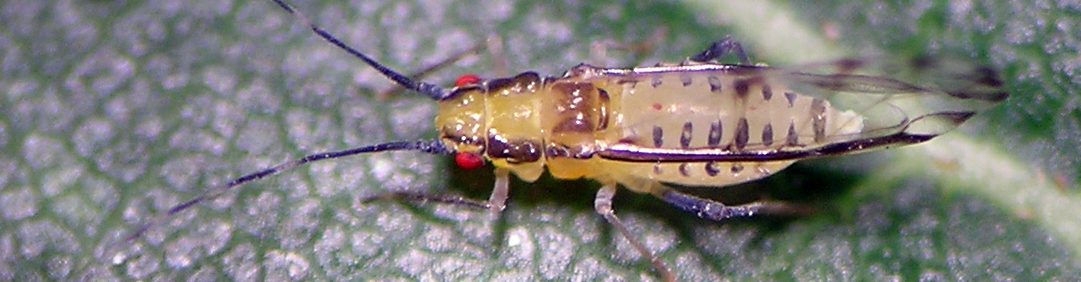
A Brief Assessment of Wahlgreniella in Western USA
Andrew Jensen, Olathe, Colorado
February 2026
So. Wahlgreniella. Like my previous essays on Obtusicauda, Asteraceae-feeding Illinoia, and Pleotrichophorus with short siphunculi, the current effort is spawned by my desire to have a quick way to sort my incoming specimens into pre-determined categories that may or may not be species. This genus has been a side interest of mine since the 1990s when I discovered what is possibly an undescribed species that lives on Paxistima myrsinites (Celastraceae). Since then, I’ve found additional mysterious forms and putative new species, all within a confused and poorly developed taxonomy of the genus.
The genus Wahlgreniella was coined by Hille Ris Lambers in 1949. Unlike many genera at their creation, this one was actually described, including rationale. Too often in the early days a genus would be created simply by coining a name and placing one or more species in it. Hille Ris Lamber initially placed 3 species in the genus, one of which has unfortunately been transferred to Neoamphorophora. The features he thought justified unifying these species under a new genus name were, clavate (a.k.a. swollen) siphunculi that lack subapical reticulation (i.e., much as in Amphorophora) but are imbricated throughout, a usual lack of rhinaria on ANT III in apterae (which feature he admitted did not always hold), usual presence of only 5 setae on the cauda, and alatae with dark bordered wing veins. As is the case today, the species were associated with Rosa and Ericaceae. The way I view this genus is that it is more or less Ericaphis with clavate siphunculi. Another genus that is almost certainly part of the complex is Rhodobium, which in my view is a mix of basically Ericaphis but with rhinaria on ANT III; it differs from Wahlgreniella, all species considered, only in the cylindrical siphunculi.
I wrestled with how to assemble this essay, but I think it may be best to do something like I did with Obtusicauda. First, conduct a new sort of all my slides, developing a list of features that I think useful in species-level taxonomy. Second, summarize what has been reported in the literature about the recognized species and their synonyms. Third, reveal any species determinations that have been applied to my collection based on the work. Finally, provide summary thoughts and suggestions for future research.
Features (“characters”) useful in my sorting
As I explained in my Obtusicauda essay and elsewhere, I’m not a proponent of constructing aphid taxonomy based on length measurements and ratios thereof due to the extreme variability that some genera and species exhibit. Plus, it is of course easier if taxonomy can be assessed without measurements, focusing on presence/absence questions.
- Spinules on head. Ever since I started my own aphid taxonomy research, I’ve studied mostly Macrosiphini, and many of the genera show useful variability in terms of ornamentation of the head capsule with spinules (called spicules by some authors). Wahlgreniella is such a genus. Spinules are sometimes limited to places such as the inner faces of antennal tubercles, or small strips extending from front to back between the median tubercle and antennal tubercle on both sides. Sometimes spinules cover almost the entire ventral surface of the head. Sometimes there are a few spinules dorsally on the antennal tubercles or dorsally between the posterior setae and the more anterior discal setae. In Wahlgreniella, there seem to be consistent combinations of these spinule patterns that are quite useful.
- Pigmentation of ANT III. Many Wahlgreniella specimens have a typical pigmentation of the antennae consisting of very dark joints between segments. There are exceptions, however, and this feature is easy to see and interpret.
- Rhinaria on ANT III of apterae and alatae. A typical state for Wahlgreniella is a lack of rhinaria on ANT III of apterae and a relatively small number (i.e., less than 15) in alatae that are scattered along the whole length in a single row. So, when a species is found that has rhinaria on ANT III in apterae or more than a single row of large rhinaria in alatae, that feature is useful.
- R IV+V length compared to HT II. This commonly used feature in aphid taxonomy is not as useful as in some groups, the lengths of both R IV+V and HT II being quite similar among all specimens of the genus. Still, there are subtle and consistent differences.
- Swelling of siphunculi. As noted above, the swelling of siphunculi in their apical half is important in recognizing Wahlgreniella, and the degree of swelling has some utility in species taxonomy as well. A simple way to assess swelling is to compare the width of the thickest part to the thinnest part more basally.
- Marginal and spinal tubercles. The presence/absence, size, and shape of marginal and spinal tubercles seem to be somewhat useful in this genus, although much variability would seem to plague the use of this feature.
- Length of setae. Most Wahlgreniella have very short dorsal setae on head, thorax, and abdomen, but some variability exists and jumps out at you when seen.
- Pigmentation of tibiae. There seems to be useful variability in tibia pigmentation, but such can be subtle. More study than I present here may be needed.
The features I discuss below are for the apterae unless specified otherwise.
Sorting my Slides
The first step in this project was sorting my 186 slides of this genus. I had, of course, attempted sorts in the past, but these were always hurried as part of my annual identifications of new slides. This time I started from scratch, lining up the slides in groups on my microscope table. I first tackled all the specimens that had been collected on Rosaceae. I followed this with the Ericaceae samples because of the idea in the literature that they are secondary host forms of species that live on Rosa. Below I present my final results, not in the order of my work.
Species #1, living on Rosa and various Ericaceae
For years I have known that there are two obviously distinct groups of Wahlgreniella common on Rosa in western U.S.A., a chief distinction being the degree of swelling in the siphunculi. I started this work by sorting the set of specimens that have relatively strongly clavate siphunculi. For the samples on Rosa, I have all life cycle morphs, but note that apterae are very few – most of my collections are fundatrices, alatae, and sexuales. My Rosa samples are from Oregon, California, Nevada, Colorado, and New Mexico. I have little to say about the species of Rosa involved because my species-level taxonomy of Rosa is very poor. After evaluating all my Rosa samples, I then looked at the Ericaceae samples to see if it seemed like they were conspecific with this clavate-siphunculus Rosa feeder. I concluded that they were, but hasten to note that it seemed like most Ericaceae specimens have slightly longer R IV+V than specimens from Rosa. My samples from Ericaceae included apterae, alatae, and alate males collected on a few species of Arctostaphylos, Arbutus, Rhododendron, and unidentified ornamentals. I have 58 slides of both host plant groups combined. These samples came from British Columbia, Washington, Oregon, California, and Colorado. Features that I found useful in unifying this group:
- Siphunculi distinctly swollen in apical ½, thickest part almost twice the thinnest
- Siphunculi dusky to brown on swollen apical portion, often abruptly darker than pale stem
- Head with only a few spinules clustered ventrally on either side of the median tubercle
- R IV+V consistently a bit longer than HT II. Somewhat worrying is that the R IV+V seems to be consistently a bit longer in specimens on Ericaceae than those on Rosa. The absolute difference is small but seems consistent and obvious after looking at many specimens.
- Setae on dorsum very short
- Marginal and spinal tubercles often present but quite small in terms of both width and height
- Apterae without rhinaria on ANT III (except in alatiform specimens – check for vestigial ocelli and/or wings), alatae with <~15 large rhinaria in a single row
- Tergum smooth to lightly wrinkled
Species #2, living on Rosa, with clavate siphunculi, extra head spinules
As I looked through all my samples from Rosa that have strongly clavate siphunculi, I noticed a group that clearly stands out from Species #1 above. These specimens have very similarly clavate siphunculi to Species #1 but differ in spinulation of the head and density of rhinaria on ANT III of alatae. Morphs available are fundatrix, apterae, and alatae. The samples (13 slides) seem to all be from forested natural vegetation in Washington, Oregon, Alberta, Montana, Idaho, and Colorado. Features that I found useful in unifying this group:
- Siphunculi distinctly swollen in apical ½, thickest part almost twice the thinnest
- Siphunculi dusky to brown on swollen apical portion, often abruptly darker than pale stem
- Spinulation on ventral surface of head extensive, plus dorsum of head between posterior discal setae on antennal tubercles with a few strong spinules
- R IV+V consistently a bit longer than HT II
- Setae on dorsum very short
- Spinal tubercles on head and ABD VIII usually large
- ANT III of apterae without rhinaria, alatae with more than 20 small-ish rhinaria in a sort of double row over full length, ANT IV sometimes with 1 or 2 rhinaria
Species #3, living on Rosa, with almost cylindrical siphunculi
This one I’ve been aware of and puzzled over for many years now. It seems to be the most common Wahlgreniella on ornamental roses, and on native or naturalized species near towns and cities. It has also been found in natural systems. I have 41 slides from Washington, Oregon, California, Idaho, Montana, Nevada, Colorado, New Mexico, and Nebraska. I have all morphs of the life cycle, with most samples being either only apterae or being mixed apterae and alatae. I worry a little about the sorting of this group since it relies rather heavily on degree of swelling of the siphunculi, a subjective feature. Features that I found useful in unifying this group:
- Siphunculi nearly cylindrical, thickest part about 20% thicker than thinnest part
- Siphunculi usually not strongly pigmented
- Spinulation on ventral surface of head extensive, plus dorsum of head between posterior discal setae on antennal tubercles sometimes with a few strong spinules
- R IV+V length usually about equal to, or slightly shorter than, HT II
- Setae on dorsum short
- Spinal tubercles variable, but usually broad on head
- Marginal tubercles usually very broad and nearly flat, largest on thoracic segments, on abdomen they are often blended with moderately to strongly wrinkled tergum
- Apterae without rhinaria on ANT III, alatae with <~18 rhinaria in a single row
The specimens from farther east (e.g., Nebraska, Colorado) and from higher elevations tend to look slightly different. One could worry that 2 species are involved, but I chose to group them for now.
Species #4, pale with long setae in coastal Washington
I have only 2 slides from 2 samples collected 2 days apart along the coast of northwestern Washington in May of 2014. They are so strikingly different from other samples from Rosa, though, that I feel compelled to highlight them here. They were found on roadside roses, possibly invasive species, but like always with Rosa, I did not attempt a species identification. Features that I found useful in unifying this group:
- Head entirely without spinules or nearly so
- Siphunculi short-ish, thick, pale, clavate (thickest part ~30% thicker than thin part)
- Setae on head and legs unusually long, posterior discal setae almost as long as basal diameter of ANT III, setae becoming extremely dense on apical part of tibiae
- Legs pale except for tips of tibiae and tarsi, which are dusky
- R IV+V a bit longer than HT II
Species #5, living on Rosa stellata in New Mexico
In September of 2014 I was collecting in the mountains of the Lincoln National Forest (New Mexico) and was walking through the mountain-top solar observatory site called Sunspot (about 2800 meters elevation), through a blowing fog. On the highest parts of the mountain grows a rose, with strange morphology, that I had never seen elsewhere and on it was a Wahlgreniella that looked different from anything I have seen before. Because of the enigma of this sample, I focused on finding this Wahlgreniella a second time during our 2023 visit to New Mexico. We camped not far from Sunspot in early October and took a day trip to visit the site. Alas, the parking area required a fee, and being misers we refused to pay it. So, we found a roadside pullout nearby and hiked back toward Sunspot through heavily grazed (cattle), abused and trashed (humans), and dry (climate change) forest land. About to lose hope, and right when I was going to suggest turning around, I spotted a stand of rose growing near some abandoned trash and car parts. These roses had almost no leaves but had the weird spiny stems and prickly hips I remembered from my 2014 visit. Tapping on these plants revealed surprisingly abundant Wahlgreniella looking just like I remembered. It turns out that the rose is Rosa stellata, a desert-inhabiting rose of New Mexico, Arizona, and Texas. Given the high elevation location of Sunspot, these plants were likely intentionally planted in the area or naturalized there due to accidental introduction. Presumably the aphid would be found in the rose’s more typical habitat, but that is yet to be confirmed. I have 2 samples now, all apterae, both from the Sunspot Observatory. Features that I found useful in unifying this group:
- ANT III with 2 to several rhinaria near base to scattered along full length
- Antennae dark beyond extreme base of ANT III
- Few spinules on the head
- R IV+V longer then HT II
- Tibiae more or less dark
- Siphunculi dark over apical ~ 3/4, only slightly clavate (~ 10% thicker than thinnest part), almost smooth
Species #6, living on Paxistima myrsinites
As mentioned at the top of this essay, finding this aphid for the first time is what really got me going studying Wahlgreniella. Since my first find of it, I have collected it in British Columbia, Washington, Oregon, and Idaho. I also have a few samples from Colorado, but they are morphologically different from the specimens in the Northwest. Ultimately, I am not sure that there is a separate species here. The samples from the Northwest are awfully similar to those I find on Rosa and Ericaceae (Species #1 above). The specimens from Colorado are a sort of mish-mash of Species #1 and Species #2. For important features, one can pretty much repeat what I wrote for those 2, except that the single alata I have of the Northwest form has only 4 and 6 rhinaria on its ANT IIIs, which would be a significant feature if we knew it was consistent. Alas, with only one specimen, we cannot rule out developmental deformities such as it being an apteriform alata (we have alatiform apterae, so why not apteriform alatae?). Arguing against such developmental issues is the fact that this single specimen has fully developed wings. In any event, I want to point out that there is a Wahlgreniella phenomenon on Paxistima in western North America. My samples include all life cycle morphs.
Species #7, living on Fallugia paradoxa
This species was first pointed out to me by a colleague who had gotten a sample from a friend and fellow entomologist. It lives on Fallugia paradoxa (Rosaceae), a common shrub in the southwestern states that lives on dry slopes of mountains down to the desert foothills. I so far have samples from Colorado, New Mexico, and Arizona. Almost all specimens I’ve encountered were apterae, but I did manage to get into some alatae on a couple occasions. I have one large set of specimens, collected on 23 March, that looked like fundatrices in the field, but under a microscope I’m not sure whether they are fundatrices or regular apterae. Despite much searching, I’ve never seen sexuales. Given the warm southwestern environment, though, it’s possible that sexuales occur later than our usual trip to New Mexico in September or October. Features that I found useful in unifying this group:
- Head without spinules
- Antennae dark brown beyond extreme base of III
- ANT III in apterae without rhinaria, alatae with ~12 in a single row
- Siphunculi only slightly clavate, thickest part about 30% wider than narrowest part basad
- Siphunculi mostly dusky to brown, basal ¼ sometimes more or less pale
- Dorsal setae long compared to other Wahlgreniella, about equal to the basal width of ANT III
- R IV+V clearly longer than HT II
Summary of Existing Knowledge of the Species Recognized as Valid
The literature of Wahlgreniella and its species is long and complicated and there is no way I can, in a reasonable time period, cover all mentions of all species as I tried to do with Obtusicauda. So, I think I’ll try to summarize what I can glean from reading about each currently recognized species. The currently accepted arrangement of the taxa according to Aphid Species File shows that W. arbuti is considered a subspecies of W. nervata. I have never been a supporter of subspecies because they are almost always erected without adequate information and are merely used to point out slight variations among the researcher’s available samples. So, I am going to follow Remaudière & Remaudière (1997), who listed W. arbuti as a separate species. One thing to recall throughout most of the historical references I’ll discuss is that those workers were using microscopes far inferior to what we have today and were also evaluating their taxa mostly based upon specimens mounted in Canada balsam without clearing.
Wahlgreniella arbuti (Davidson, 1910)
Amphorophora henryi Balachowsky & Cairaschi, 1941
This species was described with a decent amount of detail (for 1910) although we are not told how many specimens were examined nor when they were collected. We are told they were collected on Arbutus menziesii (Ericaceae; a common tree along the west coast of the U.S.A.), and we are forced to suppose they were collected near Stanford University based on the title of the paper (Stanford being in the “Bay Area” south of San Francisco). Based on the body length measurements of the specimens, I’d guess they are from mid-summer. Although the amount of text Davidson provided looks good, the amount of useful detail is scant. Probably the most useful information is the hilariously small and badly drawn figures. Among them is a sketch of the aptera’s siphunculus, showing a strongly clavate shape akin to my Species #1 above. One major problem with Davidson’s description is that he says there were “about 8 smaller” rhinaria on ANT IV of alatae. I doubt this was the case and wonder whether he misinterpreted setal bases as rhinaria, this group having rather large clear setal bases.
It was apparently Mason (1925) who declared W. arbuti to be a synonym of W. nervata, a decision disagreed and agreed with by numerous subsequent authors. He noted, however, that “the amount of dilation of the cornicle varies somewhat, some specimens being only slightly swollen.” As you may recall, this difference is, I think, crucial and represents 2 or more species. He also noted that he could not find the 8 rhinaria on ANT IV mentioned by Davidson. Mason measured 10 specimens each of apterae and alatae, providing measurements of each feature on each specimen rather than giving us only ranges. Unfortunately, we don’t know the host or locality for each of these specimens. Unusually for those days, he did measure maximum and minimum width of the siphunculi, which measurements reveal the wide range of swelling he observed. He counted 11-17 rhinaria on ANT III of alatae. We know from the banded antennae in apterae that W. arbuti fits among my Species #1-3 above.
Jumping ahead, let’s see what can be learnt about the supposed synonym, Amphorophora henryi. The short answer? Nothing. I cannot even find the full reference to the paper in which this species name was coined, forgetting access to the actual paper.
Aphids consistent with W. arbuti have been known in Europe for many years, feeding on what I presume are ornamental Arbutus, Arctostaphylos, and Empetrum. These populations seem to be anholocyclic. How they relate to my species sorting above cannot be determined without access to specimens. Much has been written about these aphids in Europe, which may or may not be a confused mixture of species.
Wahlgreniella empetri Richards, 1963
Richards was fortunate to be able to collect and study the aphids of the Canadian arctic, and this was one of the species described based on that work. He had 4 apterae and 1 alata collected at Frobisher Bay, Baffin Island, 11 August 1959, the specimens living on Empetrum nigrum (Ericaceae). This species seems to have a set of features that make it easy to tell that it is distinct from my species above:
- Head with spinules, described by Richards as, “venter of head spiculose”
- Head colorless but antennae brown beyond base of ANT III
- R IV+V a bit longer than HT II
- Siphunculi dusky over apical ½
- Siphunculi swollen to about twice the diameter of basal narrow part
- ANT III without rhinaria in apterae, with 9 in the alata
- Legs pale except tips of tibiae and tarsi
- R IV+V with only 4 accessory setae (8 or more is more typical in this genus)
It seems that these 5 may be the only known specimens of W. empetri.
Wahlgreniella lampeli Rupais, 1985
Information available to me about this species is scant. The original description is in Russian and I don’t have access to the paper. It was apparently found living on Empetrum hermaphroditum in the Murmansk region (immediately east of Finland). The only taxonomic information available to me is in the key provided by Blackman & Eastop in Aphids on the World’s Plants. They reveal that W. lampeli has only 2 accessory setae on the R IV+V and that the processus terminalis is not as short as in W. empetri. Just this one feature separates it from all my species above, but I’d want to see more evidence before coming to a firm conclusion that W. empetri and W. lampeli are distinct. Fortunately, I needn’t try to figure this out because I know that these are not similar to any of my samples.
Wahlgreniella nervata (Gillette, 1908)
Amphorophora cicutae Shinji, 1917
Aulacorthum clavicornis Richards, 1972
Amphorophora halli Knowlton, 1927
Amphorophora janesi Knowlton, 1938
The history of this species is incredibly complicated and beyond my ability to wade through due mostly to a lack of access to dozens of obscure papers published all around the world since 1908. I think the best I can do is cover the original description of the main species and its synonyms.
Gillette (1908) described this species after collecting it on wild and cultivated roses in and around Fort Collins during 1907, saying it was “common upon wild and cultivated roses throughout summer and fall.” He described all morphs except the fundatrix. He avoided telling us how many specimens were involved, but from the text of the description it seems to have been a small number. Most of the taxonomic information he provided can only tell us that he was looking at one of the Wahlgreniella species with banded antennae and without rhinaria in apterae. These include my Species #1-3 above. If Gillette had told us about the number and arrangement of rhinaria on ANT III of the alata, we might be able to eliminate my Species #2 from consideration, but alas… Given the rarity of apterae of my Species #1 and #2 on roses, and the reported abundance of apterae of Gillette’s material throughout the summer on roses, I suspect that what Gillette described was my species #3 above. Let’s keep reading through the older literature to see if we can figure this out. As you might guess, the next major place to look is Palmer (1952). She described and illustrated all morphs, once again reporting that the species was common. Her illustrations of the siphunculi show slight swelling as in my Species #3, pigmentation of the siphunculi, i.e. pale with dusky tips is like Species #3, and her counts of rhinaria in the alatae and her measurements of R IV+V and HT II (about equal) are also in keeping with my observations of Species #3. She complicates the picture, however, by considering the forms on roses around town to be the same as the form on Arctostaphylos. She likely referred to Gillette’s original material in constructing her information, but we cannot be sure whether her measurements and such also included material collected from Arctostaphylos. Rather than getting into the weeds of subsequent treatments of this name, I think I’ll move onto the synonyms and try to figure out what was going on with them.
Unfortunately, we immediately run into a roadblock – I don’t have access to Shinji (1917) where he described Amphorophora cicutae. It seems that this name may not have been used again until Eastop & Hille Ris Lambers sunk it as a synonym in their 1976 catalog, all such synonymies being done without explanation. Smith & Parron (1978) in their list of North American (north of Mexico) aphids showed that the types of this species were collected in Berkeley, California. Given this fact I have a bit more trust in the synonymy decision by Eastop & Hille Ris Lambers. So, just slightly more than zero is all I have here. Let’s move on.
Richards (1972) described Aulacorthum clavicornis based on 5 apterae collected from a Rosa at Oliver, British Columbia on 1 July 1965. Why he missed this being a Wahlgreniella is a complete mystery since he had already described a species of the genus 9 years prior. In any event, Eastop & Hille Ris Lambers recognized this as a Wahlgreniella and quickly synonymized it with W. nervata. But, we better look to see if their decision was correct. First we note that the siphunculi of Richards’ species are illustrated as not strongly clavate, and as he put it, “slightly swollen on distal half.” His color notes are scant, so we don’t know about the pigmentation of the siphunculi except that the illustration shows the extreme tip beyond the swollen part to be dusky. He reports spinules (he calls them spicules) dorsally and ventrally on the antennal tubercles and says the “venter of head with a few spicules anteriorly.” These terms are vague, and the illustration only covers the dorsum, so who knows what he meant by “few” and “anteriorly.” One potentially important feature is that it appears his specimens had R IV+V and HT II equal in length. All in all, my hunch is that A. clavicornis is the same as my Species #3.
Upon opening Knowlton (1927) one can’t help but be floored by the incredibly bad species description of Amphorophora halli. We are given a 12-line description of what was apparently a single alata. We are not told where it was collected, when, nor on what host plant! We have no taxonomic discussion, comparison to other species, or anything! I have never seen such a terrible description for a new species in North America. We are not given the number of rhinaria on ANT III. I think the only useful information here is the illustration of the siphunculus (the only illustration provided) in comparison to a siphunculus of what Knowlton considered to be W. nervata: A. halli had much more swelling in apical half than in his illustration of W. nervata and the illustrations of A. clavicornis by Richards and of W. nervata by Palmer. Palmer covered this species, stating that “it differs from A. nervata only in the more swollen cornicle.” She gives the number of rhinaria on ANT III as 19-20. Based on these shreds of information, I can’t help but wonder whether A. halli was an alata of species #1 or #2.
The last name considered to be a synonym of W. nervata is Amphorophora janesi Knowlton (1938). Opening this paper, we find some very interesting information. He provided a reasonably detailed description of apterae and alatae, undisclosed numbers of both, as usual. But what is interesting is that Knowlton himself collected the sample on 2 May 1934 at Red Canyon, Utah (far southwestern part of the state) and he did not know the host plant. The truly intriguing part of the description is that he says the antennae of apterae are “black beyond base of III” and in the “Taxonomy” section he mentions that it had “dark tibiae in both aptera and alate.” Palmer (1952) brushes off this pigmentation difference, stating that “this species is very close to A. nervata and is distinguished only by the slightly shorter measurements and the darker color of the appendages.” The unidentified host brings pause because if the host were a Rosa, surely Knowlton would have recognized this. All this information combined, plus my material on roses (other than species #5) having mostly pale antennae with banded joints, makes me wonder whether the unidentified host was Fallugia paradoxa and A. janesi is my Species #7 (this area is well within the geographic range of Fallugia, and the habitat of the area is also appropriate). A possible problem with this idea is Knowlton’s measurements of R IV+V and HT II – they seem to have been about equal in length – my material from Fallugia has R IV+V consistently slightly longer than HT II. It is possible that the importance of darker appendages was discounted by Palmer and Eastop & Hille Ris Lambers because of the early spring collecting date (even though 2 May is not early within the southern Utah ecosystem). Anyhow, this kind of discovery is why it is important to review past taxonomic decisions, to look at old literature, etc.
Wahlgreniella ossiannilssoni Hille Ris Lambers, 1949
This species was described based on 6 apterae, 1 alata, and 1 ovipara from Sweden where the aphids were found feeding on Arctostaphylos uva-ursi. Subsequently it has apparently been shown to use Rosa as primary host in high elevations, migrating to Arctostaphylos in the second generation (all according to Blackman & Eastop). According to Hille Ris Lambers its distinctive feature was a cluster of rhinaria near the base of ANT III in apterae. He states that “apterae of this species are easily recognized but alatae rather resemble those of nervata subspec. vaccinii Theobald.” I assume that the ANT III rhinaria is the feature he had in mind for apterae. The fact that he saw the rhinaria on a swollen bit of the segment and that they also occur in the ovipara indicates to me that his specimens were not alatiform. He also notes that the head is “completely smooth” and his measurements indicate that the siphunculus is fairly strongly clavate. I think we can therefore conclude that this species is not one of my 7 set out above.
Wahlgreniella vaccinii (Theobald, 1924)
This species was described from England, collected 14 July 1923, living on Vaccinium vitis-idaea. Theobald’s description was brief and of almost no use in modern taxonomy. I think the most detailed coverage was by Hille Ris Lambers (1949), who treated it as a subspecies of W. nervata. He unfortunately confused his discussion of it by including within it samples from Colorado living on Arctostaphylos; as far as I can tell his listing of this genus as a host plant is based on North American records, not European. Even his descriptive text is muddled by inclusion of samples from both plants and continents. It sounds like European specimens have strong, more or less parallel-sided antennal tubercles with what Blackman & Eastop called, “a markedly scabrous region protruding ventrally” and they added that “HT II only sparsely imbricated.” Based on these features, I don’t think what I see on Ericaceae in the U.S.A. is W. vaccinii. The one record I can find of W. vaccinii on a Vaccinium in North America was by Robinson (1979), who found it on Vaccinium uliginosum at Churchill, Manitoba, which is at about 58 degrees north on Hudson Bay. He gave no taxonomic information about his find, simply listing it under the name W. vaccinii. I have avidly collected aphids from Vaccinium for almost 40 years across western North America (amounting to hundreds of slides across the relevant genera) and have never seen a Wahlgreniella. All information considered, I suspect that W. vaccinii is a native of Europe, possibly with a native distribution into the Arctic regions of North America.
Wahlgreniella viburni (Takahashi, 1925)
This species was described from Taiwan (then known as Formosa) collected from Viburnum arboricolum (“a few” alatae) and Mahonia morrisonensis, the latter host apparently being used for description of the apterae. These alatae had “about 45” rhinaria on ANT III, 8-10 on ANT IV and 0-3 on ANT V. This feature sets it apart from all other Wahlgreniella. I think we must worry, however, whether Takahashi’s alatae and apterae were in fact the same species. His apterae had no rhinaria on ANT III but otherwise his description is inadequate. I think it best that I consider this species to be different from all my North American Wahlgreniella.
Summary notes on my evaluation of recognized species.
Wahlgreniella arbuti (Davidson, 1910): I think this should be considered a separate species from W. nervata and, given its status as the oldest name in the genus and the type species, I think this name should be used for most (all?) North American samples collected on Ericaceae and some of the samples with strongly clavate siphunculi living on Rosa. My guess is that my Species #1 would be best called W. arbuti. Because I cannot access the paper that coined the name of its synonym, Amphorophora henryi, I cannot comment on the validity of the synonymy.
Wahlgreniella empetri Richards, 1963: this seems like a good, recognizable species that is probably an Arctic specialist.
Wahlgreniella lampeli Rupais, 1985: this is probably also an Arctic specialist, may or may not be distinct from W. empetri, and seems to not be any of the species I see in lower latitudes of North America.
Wahlgreniella nervata (Gillette, 1908): based on Gillette’s material and subsequent coverage of it, I think my Species #3 should be considered W. nervata. If we accept this idea, then this aphid lives almost exclusively on Rosa (I have one slightly odd sample that was collected on ornamental Potentilla fruticosa in central Washington). It does well on ornamental roses, naturalized and native roses in urban and human-disturbed sites, and on native roses in natural systems.
Amphorophora cicutae Shinji, 1917: given lack of access to the original description and no available information on the taxonomy of the specimens, I think we must leave this as a synonym. I think it possible that this was a description of either W. arbuti or W. nervata, so if the types were ever found it might end up being moved to W. arbuti.
Aulacorthum clavicornis Richards, 1972: based on all the evidence available, I think this is correctly listed as a synonym of W. nervata.
Amphorophora halli Knowlton, 1927: based on what I can see, this is likely more correctly listed as a synonym of W. arbuti, but I cannot be sure.
Amphorophora janesi Knowlton, 1938: as noted above, I think it likely that this is NOT a synonym of W. nervata and is likely my Species #7 with a true host plant being Fallugia paradoxa (see below).
Wahlgreniella ossiannilssoni Hille Ris Lambers, 1949: this species seems to be fine, in the greater W. nervata/arbuti/vaccinii group, but distinct.
Wahlgreniella vaccinii (Theobald, 1924): I suspect that this is a European species that uses Vaccinium as host and may be able to use other Ericaceae. From my lab in Colorado, I cannot comment on what is going on with Wahlgreniella on Rosaceae and Ericaceae in Europe. It does indeed sound likely that there have been a couple introductions from North America in addition to whatever W. ossiannilssoni and W. vaccinii are.
Wahlgreniella viburni (Takahashi, 1925): it seems likely that this is not a Wahlgreniella, and it seems certain to not be one of my North American species.
The 7 Wahlgreniella Species in My Collection.
Much as I did with the Obtusicauda essay, I think I’ll cover these in order with identified species first in alphabetical order, then numbered species in numerical order. Yes, the arrangement of names below differs from what is currently accepted in Aphid Species File and elsewhere but remember: this essay and my entire website is just for entertainment and does not represent an attempt at official taxonomy or nomenclature. Known distributions listed are based on my collection only.
Wahlgreniella arbuti (Davidson) – Species #1
As noted above, I think this is the best name we can use for the Wahlgreniella that seems to use both Rosa and Ericaceae as hosts and that has strongly clavate siphunculi. It is the oldest name, and I think W. nervata is a different species (see above and below).
Host plants: Rosa species both wild and cultivated, Arbutus and Arctostaphylos both wild and cultivated, and apparently a few other Ericaceae, which were not identified in collection. As alluded to above, my samples provide support for the hypothesis of heteroecy for this species. I have very few apterae from roses, most samples from rose being alatae. Further, I have on several occasions found only colonizing alatae on Arcostaphylos at the time of year that aphids are migrating away from primary hosts including Rosa.
Habitats: From ocean coast to over 3,000 meters elevation in the Rocky Mountains, wet coastal forest to dry Ponderosa pine or lodgepole pine forests.
Distribution of my samples: British Columbia, Washington, Oregon, California, Idaho, Utah, Nevada, Colorado, and New Mexico.
Recognition features: color in life green , yellowish, pink, sometimes green with red head; siphunculi distinctly swollen in apical ½, thickest part almost twice the thinnest; siphunculi dusky to brown on swollen apical portion, often abruptly darker than pale stem; head with only a few spinules clustered ventrally on either side of the median tubercle; R IV+V consistently a bit longer than HT II; setae on dorsum very short; marginal and spinal tubercles often present but quite small in terms of both width and height; apterae without rhinaria on ANT III, alatae with about18 or fewer large rhinaria in a single row; tergum smooth to lightly wrinkled.


Wahlgreniella janesi (Knowlton) – Species #7
I am so glad to have dug through the old literature on this genus! The material Knowlton provided about this species points very strongly toward it being my Species#7 that lives on Fallugia paradoxa. Making this identification reminds me of the time before the internet and before Blackman & Eastop’s Aphids on the World’s Plants. In those days we had to scour the older primary literature ourselves, looking for the tiniest clues left by previous authors intentionally or accidentally. In this case I think I have adequate information to stick my neck out, like I would have done in 1990, and put names on these slides.
Host plant: this aphid is only known to feed on Fallugia paradoxa (Rosaceae), also known as Apache plume. This is a common shrub of the southwestern states. I have some specimens from Arizona in March that might be fundatrices, but otherwise all I can find is apterous and alate viviparae of this species despite extensive searching for sexuales in October on a few occasions.
Habitats: This aphid’s host plant can be found growing along dry stream channels, in dry foothills forests, and in forest openings and roadsides in the mountains. The aphid seems to be picky about its habitat or perhaps the physiological status of its hosts – I sometimes tap on dozens of individual plants before finding one that hosts this aphid. More observations throughout the growing season and across seasons might resolve what the aphid needs or prefers in terms of habitat and host plant status (e.g., age, size, growth stage, etc.).
Distribution of my samples: Arizona, Colorado, and New Mexico.
Recognition features: Color in life green to yellowish green; head without spinules; antennae dark brown beyond extreme base of III; ANT III in apterae without rhinaria, alatae with ~12 in a single row; siphunculi only slightly clavate, thickest part about 30% wider than narrowest part basad; siphunculi mostly dusky to brown, basal ¼ sometimes more or less pale; dorsal setae long compared to other Wahlgreniella, about equal to the basal width of ANT III; R IV+V clearly longer than HT II.


Wahlgreniella nervata (Gillette) – Species #3
After looking at all the early coverage of W. nervata, especially that which included examination of types, I think my Species #3 is Gillette’s W. nervata. This conception of the species is a monoecious inhabitant of Rosa, doing well on these plants throughout the growing season. I have all morphs of this species, although I confess that few sexuales have ever been found.
Host plants: Rosa species both wild and cultivated, possibly occasionally other Rosaceae shrubs.
Habitats: this is actually kind of interesting – despite my years of living in western Oregon and collecting a fair bit near the ocean coasts of Oregon and Washington, I have no samples from west of the Cascade Mountains. So, habitats for my samples were mid-elevation interior towns and roadsides, often in dry semi-desert settings, up to mountain slopes in Colorado at over 3,000 meters.
Distribution of my samples: Washington, Oregon, California, Idaho, Montana, Nevada, Colorado, New Mexico, and Nebraska.
Recognition features: lite to medium green, sometimes yellowish green; siphunculi nearly cylindrical, thickest part about 20% thicker than thinnest part; siphunculi usually not strongly pigmented; spinulation on ventral surface of head extensive, plus dorsum of head between posterior discal setae on antennal tubercles sometimes with a few strong spinules; R IV+V length usually about equal to, or slightly shorter than, HT II; setae on dorsum short; spinal tubercles variable, but usually broad on head; marginal tubercles usually very broad and nearly flat, largest on thoracic segments, on abdomen they are often blended with moderately to strongly wrinkled tergum; apterae without rhinaria on ANT III, alatae with <~18 rhinaria in a single row.
Alas, this species is so pale that getting decent photos of slide mounted apterae with my poor equipment is difficult.


Wahlgreniella Species #2
I had not recognized this category in all my previous sorting of Wahlgreniella slides. It was only when sitting down to go through all of them that this one was evident. The apterae stood out a bit for the relatively extensive spinulation of the head compared to W. arbuti, plus the more swollen siphunculi compared to W. nervata. The alatae, however, really stand out with their smaller and denser rhinaria on ANT III.
Host plants: Rosa species, so far all but 1 of my samples are native roses.
Habitats: All but 1 of my samples are from forested mountainous sites from about 1,000 meters in Oregon to over 3,000 meters in Colorado.
Distribution of my samples: Alberta, Washington, Oregon, Idaho, and Colorado.
Recognition features: light green, green, yellowish green; siphunculi distinctly swollen in apical ½, thickest part almost twice the thinnest; siphunculi dusky to brown on swollen apical portion, often abruptly darker than pale stem; spinulation on ventral surface of head extensive, plus dorsum of head between posterior discal setae on antennal tubercles with a few strong spinules; R IV+V consistently a bit longer than HT II; setae on dorsum very short; spinal tubercles on head and ABD VIII usually large; ANT III of apterae without rhinaria, alatae with more than 20 small-ish rhinaria in a sort of double row over full length, ANT IV sometimes with 1 or 2 rhinaria.


Wahlgreniella Species #4
As noted above, this species is tentatively set out because it is so different from the others, especially in terms of setal length and very pale appendages.
Host plants: Roadside Rosa, possibly adventive species.
Habitats: My 2 samples are from roadside plants very near the ocean in northwestern Washington at elevations of less than 50 meters.
Distribution of my samples: Washington.
Recognition features: green in life; head entirely without spinules or nearly so; siphunculi short-ish, thick, pale, clavate (thickest part ~30% thicker than thin part); setae on head and legs unusually long, posterior discal setae almost as long as basal diameter of ANT III, setae becoming extremely dense on apical part of tibiae; legs pale except for tips of tibiae and tarsi, which are dusky; R IV+V a bit longer than HT II.
I would love to provide a photo of this species, but mounted specimens are so nearly colorless that my equipment is inadequate.
Wahlgreniella Species #5
This unusual species is easily recognized and stands out both for its morphology, for its odd host plant, and for the only location I have found it.
Host plants: Rosa stellata.
Habitats: My samples are from high elevation forested environments, but I suspect the Rosa stellata in that location may be abandoned ornamentals, or naturalized descendants of plants used as ornamentals around the Sunspot observatory and research site. It will be important to study this plant across its more normal range.
Distribution of my samples: New Mexico.
Recognition features: color in life green; ANT III with 2 to several rhinaria near base to scattered along full length; antennae dark beyond extreme base of ANT III; few spinules on the head; R IV+V longer then HT II; tibiae more or less dark; siphunculi dark over apical ~ 3/4, only slightly clavate (~ 10% thicker than thinnest part), almost smooth.

Wahlgreniella Species #6
I am least confident in this species being distinct from the others. Although I can consistently find Wahlgreniella on Paxistima almost everywhere I go, the facts that the Colorado samples look rather different from the rest, and that all other samples seem almost inseparable from what I am calling W. arbuti argue for Paxistima simply being an acceptable alternative host for W. arbuti. Experimentation may be required to reach a stronger conclusion. I retain these samples as separate mostly because I have accumulated all morphs on Paxistima and I am cautious about considering a species capable of developing through an entire life cycle on such distantly related plants.
Host plants: Paxistima myrsinites (Celastraceae).
Habitats: I find this aphid in most places that Paxistima grows strongly, and sometimes even in places where Paxistima plants are few and very small, tucked under the canopies of dense spruce and firs. These are moderate to high-elevation forest sites.
Distribution of my samples: British Columbia, Washington, Oregon, and Idaho. The Colorado samples may represent a different species.
Recognition features: color in life green, occasionally reddish; siphunculi distinctly swollen in apical ½, thickest part almost twice the thinnest; siphunculi dusky to brown on swollen apical portion, often abruptly darker than pale stem; head with only a few spinules clustered ventrally on either side of the median tubercle; R IV+V consistently a bit longer than HT II; setae on dorsum very short; marginal and spinal tubercles often present but quite small in terms of both width and height; apterae without rhinaria on ANT III, the single available alata with 4 and 6 rhinaria; tergum smooth to lightly wrinkled.


Needs for additional research.
For the 2 people who might have read this far, it is probably obvious that some host plant transfer experiments are called for. Highest priority will be transfers from Rosa to Arbutus, Arctostaphylos, and other Ericaceae, plus transfers between Rosa and Paxistima. Of secondary interest might be transfers among Rosa species, between Arbutus and Arctostaphylos, etc.
Much as was the case for Obtusicauda, collecting outside my usual range of travel will be important, such as the U.S. states of Montana, Wyoming, Nebraska, the Dakotas, eastern Colorado, Oklahoma, Texas, New Mexico, Arizona, and California plus Canadian provinces such as British Columbia and Alberta.
I have focused very little of my taxonomic effort on measurements of body parts and ratios of those measurements and have side-stepped some of the setal counts that might be useful in this genus. To do a thorough job of analyzing Wahlgreniella it will be necessary to take many such measurements and evaluate the data for interesting patterns and trends.
Species-level identification of host plants, especially the many roses involved, might be important. This is highlighted by the oddity of Species #5 feeding on Rosa stellata.
Finally, I think we must evaluate how the species of this genus are related to those currently placed in Ericaphis and Rhodobium plus some species in other genera such as Acyrthosiphon (e.g., Acyrthosiphon macrosiphon) There seem to be closely related species scattered among these genera that are separated morphologically because of easily evaluated features such as clavate versus cylindrical siphunculi but that are otherwise very similar and possibly closely related.
Key to Species in My Collection
1. Antennae of apterae entirely dark beyond base of ANT III … 2
— Antennae of apterae mostly pale, pigmentation of ANT III and IV limited to banded apices … 3
2. ANT III in apterae with a few to several rhinaria; living on Rosa … Wahlgreniella Species #5
— ANT III in apterae without rhinaria; living on Fallugia paradoxa … Wahlgreniella janesi
3. Posterior discal setae on vertex of head about as long as the basal width of ANT III; siphunculi appearing short and thick, almost entirely pale; on Rosa … Wahlgreniella Species #4
— Posterior discal setae on vertex of head much shorter than basal width of ANT III; siphunculi usually pigmented over apical ~ ½ … 4
4. Siphunculi only slightly clavate, about 30% thicker at widest than at narrowest point basad; R IV+V and HT II about equal in length, R IV+V often shorter than HT II … Wahlgreniella nervata
— Siphunculi more strongly clavate, often approaching twice as wide at widest point than at narrowest point basad; R IV+V consistently a bit longer than HT II … 5
5. Apterae with extensive spinulation of the head, covering most of ventral surface and usually extending to a cluster on top of head near antennal tubercles; ANT III in alatae with more than 20 small-ish rhinaria in a sort of double row over full length, ANT IV sometimes with 1 or 2 rhinaria … Wahlgreneilla Species #2
— Apterae with head having only a few spinules clustered ventrally on either side of the median tubercle; ANT III in alatae with fewer than 20 rhinaria in a more or less straight row, without rhinaria on ANT IV … 6
6. Living on Rosa and Ericaceae … Wahlgreniella arbuti
— Living on Paxistima … Wahlgreniella Species #6
References Cited
Davidson, W.M. (1910) Further notes on the Aphididae collected in the vicinity of Stanford University. Journal of Economic Entomology, 3(4), 372–381.
Eastop, V.F. & Hille Ris Lambers, D. (1976) Survey of the World’s Aphids. Dr. W. Junk, The Hague, 573 pp.
Gillette, C.P. (1908) New species of Colorado Aphididae, with notes upon their life-habits. The Canadian Entomologist, 40(2), 61–68.
Hille Ris Lambers, D. (1949) Contributions to a monograph of the Aphididae of Europe IV. Temminckia, 8, 182–323.
Knowlton, G.F. (1927) Notes on a few Amphorophora (Aphididae) of Utah. The Pan-Pacific Entomologist, 3(4), 185–186.
Knowlton, G.F. (1938) Three Macrosiphina aphids. Journal of the Kansas Entomological Society, 11(1), 13–16.
Mason, P.W. (1925) A revision of the insects of the aphid genus Amphorophora. Proceedings of the United States National Museum, 67(20), 1–92.
Palmer, M.A. (1952) Aphids of the Rocky Mountain Region. The Thomas Say Foundation, 5, 452 pp.
Remaudière, G. & Remaudière, M. (1997) Catalogue of the World’s Aphididae. INRA, Paris, 473 pp.
Richards, W.R. (1963) The Aphididae of the Canadian Arctic (Homoptera). The Canadian Entomologist, 95(5), 449–464.
Richards, W.R. (1972) Three new species of Aulacorthum from British Columbia, with a key to the Canadian species (Aphididae: Homoptera). The Canadian Entomologist, 104(7), 1017–1023.
Robinson, A.G. (1979) Annotated list of aphids (Homoptera: Aphididae) of northwest Canada, Yukon and Alaska. The Manitoba Entomologist, 13, 23–29.
Smith, C.F. & Parron, C.S. (1978) An annotated list of Aphididae (Homoptera) of North America. North Carolina Agricultural Experiment Station Technical Bulletin, 255, 428 pp.
Takahashi, R. (1925) Aphididae of Formosa Part 4. Report of the Department of Agriculture Government Research Institute Formosa, 16, 65 pp.
Theobald, F.V. (1924) New and little known British aphides. Entomologist’s Monthly Magazine, 60, 124–130.