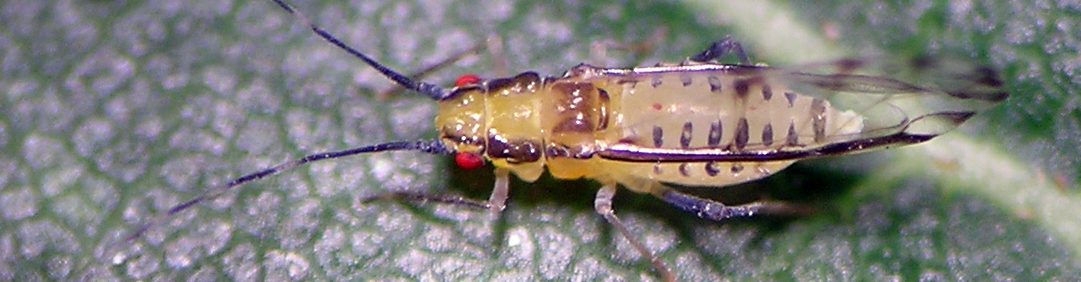
Asteraceae-feeding species of Illinoia in western U.S.A.
Andrew Jensen, Olathe, Colorado
December 2025
The year 2021 was our first living in western Colorado. It was overall a light year for collecting Illinoia, with the exception of samples from various Asteraceae. My first collecting goal here was finding Illinoia masoni, which is known to feed on native Helianthus (the sunflower genus). To my surprise, finding this species was easy — it lives on native Helianthus and apparently other Asteraceae herbs all over our local mountains. I had wondered whether this species would be morphologically distinguishable from other Illinoia living on Asteraceae, such as I. goldamaryae, I. grindeliae, and I. subviride. During December of 2021 I carefully sorted through the specimens I had identified as all these 4 species. Making a long story short, I was able to make most of the specimens fit into 4 groups and was able to make a case for species name assignments for each group based on old literature. Going into this sorting process I understood that 3 of these 4 species had a fairly tight host range. I thought I. grindeliae fed on Grindelia, I. masoni on Helianthus, I. subviride on Aster/Erigeron, and I. goldamaryae was thought to be oligophagous on several Asteraceae genera. Now, it seems clear to me that: I. grindeliae feeds on various desert-inhabiting Asteraceae including Grindelia, Heterotheca, and a couple others I couldn’t identify; I. masoni seems to feed on several genera in wet montane forests, including Helianthus, Helianthella, and Erigeron; so far I. subviride does in fact seem to feed only on Aster/Erigeron.
Another evaluation after much collecting in 2022 and examination of those specimens: in addition to the species mentioned above, I was able to sort 7 additional morphospecies from all my Asteraceae-feeders. I fear that I am confirming that Illinoia species mostly are not tightly host specific and have overlapping geographic ranges and morphological features.
The purpose of this essay is to summarize the results of my analyses of Asteraceae-feeding Illinoia and to provide myself a key for identification of the named species and unnamed forms I have delineated. First, I will present history and details of my understanding of each described species. Then I present each of my putative undescribed forms (a.k.a. morphospecies?) with details of their morphological and biological features as I understand them. I include rather poor photos of 4 of the species; I could provide more photos, but the species are so similar at the magnification my equipment can muster that they would be pointless. A brief discussion section will offer my thoughts on biology and relatedness of this group of species. Finally, there will be an identification key.
Before all that, though, I should comment on the characters and features I used in this brief study. To sort my specimens, I focused on characters that I can assess quickly and easily without making measurements or calculating ratios. A main useful feature in this group is the R IV+V in terms of length, shape, and number and arrangement of setae. I use vague terms like long, medium, and short, and concepts such as moderate number of setae versus many. These distinctions make sense to me, and any aphid specialist with access to my specimens would quickly see what I meant. Ideas such as heavy versus fine spinulation, tarsi short versus long, antennal tubercles large versus small, etc. are all useful, and are fairly clear once a person gets into studying these species. I ignored one feature that is sometimes useful in Illinoia taxonomy, i.e., the number of setae on tarsal segment I. I ignore this because most species have a variable number, often a single specimen having tarsi with 3, 4, and 5 setae. That said, I think there may be opportunity to find that some of the forms I discuss below that always have, for example, 3 or 4 setae versus others that always have 5. Careful examination of hundreds of little feet will be required to ascertain the utility of this feature. Similarly, I did not measure antennal segments, siphunculi, cauda, etc. attempting to discover diagnostic ratios. Instead, I use subjective terms like long, short, broad, narrow, etc. One reason for this decision is honesty: very often we aphid taxonomists cook up a diagnostic ratio for keys and such the purpose of which is to quantify our preconceived notion of, for example, long, medium, and short. Another key reason to avoid ratios is that it is difficult to find ratios that hold up, providing non-overlapping ranges of values, when scores or hundreds of specimens from multiple sites, host plants, and times of year are included. That said, I saw trends in antennal segments, siphunculi, and caudas that might yield useful ratios if a person took the time to investigate.
Illinoia goldamaryae (Knowlton 1938)
Knowlton described this species in 1938 based on material from near Logan, Utah collected on 17 June 1925. It is unclear how many specimens he had, but he seems to have measured more than 1 apterous vivipara and only 1 alate vivipara. The description is very brief and of almost no use in modern aphid taxonomy. Another name out there for this species is Amphorophora patchiae Essig (1942). He coined the name for specimens collected in New Hampshire living on Conyza canadensis collected 15 June 1937. His description is about as detailed as Knowlton’s and wholly inadequate for recognition of this species from among the diversity of similar species known today. MacGillivray (1958) sunk this name as a synonym of I. goldamaryae declaring, “I find it impossible to separate Amphorophora patchiae Essig, 1942, in any way from goldamaryae and therefore list Essig’s species as a synonym.” In a perfect world I would examine types of both species to evaluate MacGillivray’s conclusion, but alas I will not any time soon and will therefore accept her conclusion and assume that patchiae is not an available name for any of the forms in my collection.
The place I was most able to study I. goldamaryae and collect all its life cycle stages was on Solidago on the shores of Moses Lake in central Washington. I have fundatrices, oviparae, and alate males from Solidago. My specimens are from: Washington, Oregon, Idaho, Montana, Utah, Colorado, and Wyoming.
Features that I consider to be useful in species recognition include:
- ANT I-II scabrous medially
- Base and processus terminalis of ANT VI long, with BASE usually pale proximally and darker around primary sensoria
- Siphunculi appearing long
- Cauda long and parallel-sided
- R IV+V medium length, evenly tapering to acute tip, apical-most pair of accessory setae about twice the length of more basal accessory setae
This species is very similar to I. masoni, as discussed at some length by MacGillivray (1958). See below for more details about this situation.
Illinoia grindeliae (Williams 1911)
Williams (1911) described this species based on an undisclosed number of apterous and alate viviparae, providing notes mostly on color and general appearance in life, with measurements and setal counts limited to total length of body, wing, and siphunculus of a single measured alate vivipara. In other words, he provided little information useful in modern taxonomy. Knowlton (1929) described a single alate vivipara collected from Artemisia tridentata as a new species, Amphorophora aridus, and later concluded that this specimen was in fact I. grindeliae and that A. tridentata was probably a casual resting site, not a true host plant. MacGillivray (1958) attempted to make sense of this species and provided much more information. She erected a new subspecies for specimens with longer processus terminalis and shorter R IV+V than Williams’ material. Alas, she measured only 5 and 6 apterae of the two subspecies, respectively, and it took only a few specimens in my collection to break her key to subspecies (for me, breaking a key means a single specimen has features clearly within both sides of couplet, making a choice impossible). A feature MacGillivray noticed was the presence of secondary rhinaria on the ANT IV and sometimes ANT V of alatae. This is a useful feature, but as noted by Blackman and Eastop, “Alatae may have 1-2 secondary rhinaria on ANT IV and V.” Very few of the alatae among my specimens identified as I. grindeliae have rhinaria on ANT IV or V. It is unclear what to make of this fact.
Like MacGillivray, I see a frustrating amount of morphological variability but it is unclear what to do with it. My observations combined with those of previous authors suggest that the situation is complex and either this is a rather variable species capable of inhabiting a wide range of habitat types and host plants, or there is more than one species involved. As I sorted my slides in 2024 I created a category for I. grindeliae and another category for what I thought might be another similar species feeding on composites including a few genera in our local deserts. But upon another evaluation and sort in 2025 I could not see any character to separate the two groups.
This grouping of 40 slides has left me with a morphologically and biologically variable species. This conception of I. grindeliae leaves us with a species known from the ocean coast of Oregon and California to moderately high elevations (3000 meters plus) in the Rocky Mountains. Host plants include a few unidentified Asteraceae, Grindelia, Heterotheca, Erigeron, Solidago, Aster, and Gutierrezia. See the section, “Discussion and notes on biology,” below for thoughts on the life cycle and ecology of this species. I have samples from Oregon, California, Idaho, Utah, and Colorado.
Features that I consider to be useful in species recognition include:
- Antennal tubercles relatively low
- ANT I and II with medial rugose patches, a similar patch usually present on lateral side of ANT I
- Hairs on posterior of vertex short
- Siphunculi relatively short, sometimes very thick, with few or no reticulations
- Cauda not super long
- ANT VI relatively short, with a “short” Base
- R IV+V somewhat short to medium in length with variable, modest numbers of accessory setae

Illinoia (Masonaphis) magna (Hille Ris Lambers 1974)
Described by Hille Ris Lambers in 1974, this species feeds on an unidentified Asteraceae and is known from a few collections in British Columbia and Alberta. In 1965 Grant Robinson had published Macrosiphum olmsteadi, which was found living on Aster macrophyllus in Ontario. I have studied these descriptions and my many samples of specimens in this ballpark, concluding that there is almost no distinction between the two accounts other than the number of setae on first tarsal segments, with 3 recorded for M. olmsteadi and 5 for I. magna. I have mentioned elsewhere that number of setae on first tarsal segments is not as stable and useful a character as was apparently once believed, leading me to consider the two names to be likely synonymous. I ended up using the name M. olmsteadi for my samples mostly because it is the older name and would be used were the two species declared synonyms. It is reasonable to argue both sides — for two species and for one. I am choosing to keep my specimens filed under M. olmsteadi for now.
All that being said, features that I consider to be useful in species recognition include:
- R IV+V thick and moderately long with many setae
- Siphunculi long, only slightly swollen near apex, with a few rows of good reticulation, more basal imbrications mostly smooth
- Head, ABD VII and VIII usually with spinal tubercles
- ABD II-V with medium marginal tubercles
- Setae on vertex fairly long
- Tarsi fairly short with spinulate imbrications
- Ornamentation on ANT I and II strong, with big spinules/small imbrications

Illinoia masoni (Knowlton 1928)
This species was described by Knowlton (1928) from samples collected in Utah in June and July of 1925. The recorded host was Helianthus annuus, what he referred to as “young sunflowers.” The collection locality of St. George, Utah indicates that the original samples were from a garden or on plants volunteering in or near this small desert town. This initially made me suspicious as to whether these original specimens are conspecific with more typical material that I and others find on native forest-inhabiting Helianthus and other Asteraceae at high elevations. Examining the writing and figures of Knowlton (1928) and MacGillivray (1958), plus my samples from various habitats in western U.S.A., I am reasonably convinced that there is a single somewhat recognizable species we can call I. masoni.
I have samples identified as this species from Washington, Oregon, Idaho, Colorado, Utah, and New Mexico. Host plants include Helianthus, Helianthella, Erigeron, Aster, and Heliomeris. I even have a sample recorded from Solidago that I could not identify as I. goldamaryae and that seemed to fit I. masoni.
I cannot find a feature, or set of features, that consistently separate I. goldamaryae and I. masoni. That said, features that I consider to be useful in species recognition include:
- Siphunculi tending to be shorter, thicker, and more strongly imbricated than in I. goldamaryae
- ANT sensoria clustered near the base on a noticeably swollen bit of the segment (MacGillivray claims this bit is slightly pigmented, but I have not seen this, possibly due to my NaOH clearing method.)
- Base of ANT VI is usually more or less uniformly brown and shorter than in I. goldamaryae
- Antennal tubercles and ANT I-II rugose medially, and ventral protuberance on the antennal tubercles is more prominent and spinulate than in I. goldamaryae

Illinoia richardsi (MacGillivray 1958)
This aphid, described by MacGillivray in 1958, is common and easy to find on its hosts Anaphalis margaritacea and sometimes Gnaphalium. It is distinctive not only for its unusual host plant but mainly for its extremely long R IV+V. In 1966 Hille Ris Lambers wrote about finding this species on both Gnaphalium and Anaphalis in California. He noted that the specimens from Gnaphalium matched MacGillivray’s description perfectly, but for some reason he was dissatisfied with comparing his specimens from Anaphalis with the original description. He noted that “any systematist would be inclined to place it in Sitobion.” He then set out a new subspecies for his 10 specimens (6 apterae, 4 alatae) collected near Berkeley on 1 January 1964. His description very briefly attempts to point out a few differences between his observations and the original description. These differences seem to revolve around the shape and degree of reticulation in the siphunculi. He seemed to think these differences are substantial, but I don’t see why he thought that. Most of my samples are from west of the continental divide, but my single sample from Quebec is indeed slightly different, mainly in its more pronounced apical reticulation of the siphunculi. Still, the range of variation I see in my 15 samples is smaller than many other aphid ‘species’ I identify on a regular basis. His reaction to his specimens might have had something to do with their mid-winter collection date – monoecious aphids collected during winter like this often look different than the same species during the main growing season.
At the time of its description MacGillivray guessed that I. richardsi is monoecious. Since then, I have collected oviparae and males on a couple occasions, proving this life cycle.
Illinoia richardsi has an impressively large, apparently natural distribution that reflects the distribution of its host across North America. I have specimens from Washington, Oregon, Idaho, Utah, Colorado, and Quebec.
Features that I consider to be useful in species recognition include:
- Very long and thin R IV+V with about 6 short accessory setae.
- Extensive ventral spinulation on the head from antennal tubercles to rear margin of head
- Dorsal hairs on head relatively long, with those in posterior row markedly shorter and often thicker than those more anterior, combined with very short antennal setae

Illinoia subviride (MacDougall 1926)
This is one of a few interesting species noticed in British Columbia and described by Alice MacDougall in 1926. Her description seems to be based on very few specimens, possibly one each of apterous and alate viviparae, but we can’t be sure. She says her material was “first collected in Bootahnie [sic] Valley, June 27, 1925, and then at intervals until August 2 of the same year.” This implies multiple specimens, but she measured only 1 of each morph, so I suspect she used only 2 specimens for her description. And, as far as I can tell from much effort, MacDougall’s types have been lost. So, it is hard to know for sure what she was looking at. All that said, I have separated off some material and labeled them I. subviride. Characters I have used to group specimens under this name include a moderately long R IV+V with a decent number of setae, strongly spinulose ventral side of head, short tarsi, and relatively thick, almost cylindrical, and not strongly reticulated siphunculi.
I have material identified as I. subviride from 2 collections in southern Oregon living on what were probably Erigeron species in the forest at moderate elevation. In studying my material for this essay, I took a couple samples out of this species category due to mismatched siphunculi and other features, leaving us with just these two samples.
Features that I consider to be useful in species recognition include:
- Siphunculi nearly cylindrical with a few rows of fully developed reticulation
- R IV+V a bit long with extra hairs compared to I. masoni and others
- Rhinaria on III are scattered along length in apterae
- Spinules on venter of antennal tubercles and on ANT I are unusually big
Miscellaneous groups of unidentified samples
As I sorted material over the past few years, and in preparation of this essay, I separated out several groups of specimens that I cannot put existing species names on. In this section I will discuss the more distinctive of these groups of specimens and then I will include them in the key below.
Illinoia ex Asteraceae 1 — A small species that feeds mostly on Heterotheca in both desert and high elevation forest settings: I have 29 samples of this form, found from very early spring to late fall in Colorado, New Mexico, Utah, and Idaho. These specimens were pulled out of the many scores of slides that might have been identified as I. masoni or I. goldamaryae. All but a few were found living on Heterotheca, a few being collected from unidentified Asteraceae, one from what I thought was a Solidago, and a couple from Heliomeris multiflora. These were collected from elevations below 1500 meters to well above 3000 meters. Features that I use to separate these specimens from the other species/forms include:
- Antennal segment I short and looking a little compressed, smooth or with only a few large spinules or imbrications medially
- R IV+V a bit long, narrow, pointed, with about 8 accessory setae
- Body size a bit small with rather low antennal tubercles
- Ventral spinulation of the head more or less limited to the antennal tubercles
- Siphunculi with relatively slight swelling
- Tarsi a touch short
Illinoia ex Asteraceae 2 – A strange species with unusual morphology and chemistry during the clearing process: This form I have collected only twice, both times in northern California. They were found feeding on what I thought was a species of Madia with tall (~75 cm) plants and relatively showy flower heads. In terms of morphology, and in the way the specimens respond to the clearing process (i.e., internal tissues tending to solidify into large crystals that dissolve in clove oil), this form seems like a cross between Uroleucon (Lambersius) and Illinoia. The appearance and color in life reminded me of Uroleucon (Lambersius) and the coloration after clearing is also very similar, with dark siphunculi that have a small pale area basally, dark antennae in alatae, etc. The swollen siphunculi make Illinoia the best generic placement for the time being. Features that I use to separate these specimens from the other species include:
- Siphunculi mostly brown, with small pale area basally, a few rows of narrow reticulation apically, with small spinulose imbrications scattered more basally
- R IV+V very long with about 20+ accessory setae which are themselves unusually long
- Numerous rhinaria on ANT III – about 25-40 in apterae and over 50 in alatae; no rhinaria on ANT IV or V
- Tarsi fairly short and almost completely smooth, even in alatae
- Setae mostly quite long, with those on ANT III shorter than others but still a bit longer than the segment’s basal width
Illinoia ex Asteraceae 3 – A form found on Viguiera at the foot of the Magdalena Mountains in New Mexico: I have 2 collections of this form from the same late September outing, both at the outlet of Water Canyon near Socorro, New Mexico. It had been an unusually wet summer, and the desert and mountain slopes were all resplendent with flowers and huge vegetative growth of native plants. Viguiera formed waste-high thickets along the road, and this aphid was abundant in them. Morphologically and in terms of appearance in life it seems closely allied with I. goldamaryae. But it has enough unusual features to form a separate group in my collection for now:
- Siphunculi long and thin, with normal reticulation but small scattered and spinulose imbrications more basally
- Apterae with about 10-12 rhinaria in a cluster near the base of ANT III, alatae with relatively numerous rhinaria scattered over full length, 1 or a few rhinaria also on ANT IV
- Antennal tubercles large, as in I. goldamaryae and I. masoni
- Dorsal hairs very short
- R IV+V a bit long with about 12 accessory setae
- Spinules on head mostly limited to small patch on ventral side of each antennal tubercle
Illinoia ex Asteraceae 4 – Form similar to Macrosiphum olmsteadi on Arnica in central Colorado: I have 3 specimens from 2 collections in southern Colorado, collected from Arnica cordifolia in July of 2022 and 2025. These were unexpected because what I typically see on this plant, which is an extremely common understory plant in western U.S. forests, is Illinoia (Oestlundia) davidsoni. Alas, I don’t remember collecting these specimens in terms of their microhabitat. They differ from M. olmsteadi mainly in having longer tarsi that are less spinulate. Features that I use to separate these specimens from the other species/forms include:
- R IV+V fairly long and thick with numerous long setae
- Tarsi medium length with faint spinulation on the imbrications
- Spinal tubercles on head and ABD tergites VII and VIII
- Siphunculi long and thick, with moderate swollen section and spinulate imbrications more basally
Illinoia ex Asteraceae 5 – Form with a mix of unusual features living on a Solidago(?) near Socorro, New Mexico: I have a single sample composed of 4 specimens collected in September on the slopes of the Magdalena Mountains in 2016. At the time I recorded the host as Solidago, but I confess to being skeptical of my own plant taxonomy in this case. I am confident in the plant family being Asteraceae. I am usually loath to highlight single samples in this way, preferring to show that a form or species can be collected more than once. But, this one has quite a few unusual features that are worth mentioning:
- Long thin R IV+V with numerous long setae
- ANT III with ~10 unusually large rhinaria scattered over its full length (or nearly so) in apterae
- Setae on antennae and vertex unusually long – longer than basal width of ANT III
- Tarsi moderate in length with faintly spinulate imbrications
- Extensive but very fine spinulation on the venter of the head
Illinoia ex Asteraceae 6 – Large form living on tall Arnica species in southeastern Idaho: This is another example of a form I have found only once but is probably still worth pointing out. It was living on a tall thin Arnica species in a wet forested site in mountain foothills of southern Idaho in early July. The specimens are a bit on the large side for Illinoia, probably being related to I. goldamaryae and I. masoni. Features that I use to separate these specimens from the other species/forms include:
- R IV+V not particularly long nor setose
- Siphunculi long, moderately swollen with swollen part imbricated
- Cauda remarkably broad-triangular
- Antennal setae medium length
Illinoia ex Asteraceae 7 – Form with impossibly short tarsi in south-central Colorado: Alas I feel compelled to draw attention to yet another form that I’ve collected only once, including both apterae and alatae, in June. As noted, these specimens have extremely short tarsi, with the second segment barely longer than the first segment! I found these in the forested hills north of Chimney Rock, a famous ancient Native American site. Features that I use to separate these specimens from the other species/forms include:
- R IV+V average length for Illinoia on Asteraceae, but broad at base and strongly triangular with numerous setae packed throughout
- Tarsi impossibly short
- Head almost entirely smooth ventrally
- Head with notable median frontal tubercle
- Setae on vertex moderately long
- Siphunculi thin and not very clavate
Discussion and notes on biology
Relationships among these species/forms. OK! So we end up with 6 described species and 7 undescribed forms that we might call morphospecies or putative undescribed species. Several of these are distinctive and easily recognized, such as the one with impossibly short tarsi. Others are generally recognizable categories with broad gray areas between them. My guess is that my sorting is not entirely adequate, with some specimens possibly better placed in a different group than I have them now, or perhaps better pulled out in separate groups. I fear that more collecting plus detailed ecological, morphological, and/or DNA analysis may be necessary to sort out this situation more thoroughly.
All this said, I think it worthwhile to point out some trends and groups that I have noticed. My guess is that I. goldamaryae, I. masoni, I. grindeliae, Illinoia ex Asteraceae 1, and Illinoia ex Asteraceae 3 are all closely related, possibly poorly sorted, and possibly representing either more or fewer species than the categories I am currently using. They are unified by R IV+V shape being medium length, with medium setal counts, and with one pair of accessory setae usually being about twice the length of the others, the tarsi being medium length with smooth imbrications, and having generally medium to smaller body size. I am inclined to suggest that I. richardsi belongs to this group of relatives as well. Although its R IV+V is unique overall, my hunch is that I. richardsi is similar to I. goldamaryae but has developed its long R IV+V in response to its host plant, which seems to have selected for a long R IV+V in its other host-specific aphids such as Uroleucon russellae Hille Ris Lambers. Illinoia ex Asteraceae 6 may also belong to this group, but its large body size and odd, broadly triangular cauda bring pause.
Then there seems to be a group of forms (species?) that have long and heavily setose R IV+V and long siphunculi that tend to have slightly thinner clavate areas. Included in this category are Macrosiphum olmsteadi (Illinoia magna?), Illinoia subviride, Illinoia ex Asteraceae 4, and Illinoia ex Asteraceae 5. I confess to being a little uncertain whether I. subviride belongs with this group since the specimens I’ve identified as this species have a R IV+V somewhere between M. olmsteadi and I. goldamaryae and not very long siphunculi.
Two of the unidentified forms seem to be set apart from the other species and forms in this essay. Illinoia ex Asteraceae 2 stands apart for its extremely abundant rhinaria on ANT III and long dorsal setae (among other things), while Illinoia ex Asteraceae 7 looks somewhat like the second group but its much shorter and densely setose R IV+V plus its incredibly short tarsi make me wonder if it is more distantly related.
Host plant biology, migration, life cycles. Of the 13 species and forms written about here, I know the life cycles of 6 of them, while the other 7 are too poorly known. All 6 are what we in aphidology call “monoecious.” This means that the aphid is born from an egg in spring, lives on the same category (usually a species or genus) of host plant all growing season, with several generations of parthenogenetic reproduction, until new eggs are laid in the fall. The species with known monoecy are: I. goldamaryae, I masoni, I. grindeliae, I. richardsi, M. olmsteadi, and Illinoia ex Asteraceae 1. Of these, we somewhat confidently know the host plant range for only two of them, I richardsi and M. olmsteadi. The latter seems to only feed on forest-inhabiting members of Aster, especially Aster conspicua. The former is a specialist on Anaphalis margaritacea but can also use Gnaphalium. The other 4 species/forms with known life cycles seem to be oligophagous on 2 or more Asteraceae genera, with no clear boundaries on acceptable hosts. That said, I confess to ideas of preferred, or most common, host plants for them all: I. goldamaryae is most often identified from Solidago (and species formerly placed in Solidago), I. masoni is mostly found on Helianthus, and Illinoia ex Asteraceae 1 lives mostly on Heterotheca. One must, however, consider biases and confounding factors. For example, Solidago and Helianthus species are mostly large, evident, showy plants. Might we collect from these plants more frequently because we notice them more, they are easier to search, etc.? Another kind of bias might be affecting my information about I. grindeliae and Illinoia ex Asteraceae 1: since moving to Colorado I have become more familiar with Heterotheca and have avidly pursued aphids on it, trying to understand the ecology and taxonomy of the situation. A side effect of this work might be missing equally interesting interactions with other plants that are perhaps smaller, less evident, or less common.
As just noted, I have recently been especially interested in aphids on Heterotheca (common names goldenasters, camphorweed, and telegraph weed). One thing that drove this interest is the seasonality of the plant and its aphids in the piñon pine/juniper desert near our home. I noticed early on that Illinoia aphids were actively reproducing on this plant very early in spring. With adult alatae and apterae being found in late April and early May, the fundatrices must have hatched from eggs in March sometime, perhaps earlier if those alatae were third generation of the year. Putting these early collection dates in context, our part of Colorado is in USDA growing zone 5 or 6, with a last frost of the spring usually in late May or early June and perennials like trees and shrubs don’t fully bloom and leaf out until May. So, for the Illinoia aphids on Asteraceae in our deserts to be flying by May 1 is very early. Fall brings a related phenomenon: alate viviparae and alate males found colonizing Heterotheca as late as mid-October, and oviparae easily found in mid-November. To again set the context, our area gets a first frost by October 1 and severe cold snaps, and often snow, by mid-November. These shoulder season observations are combined with an almost complete lack of Illinoia aphids on our local low-elevation Heterotheca and the frequent finds on these plants at high elevations during summer. My observations made me consider the possibility that these aphids migrate seasonally through Heterotheca’s elevational gradient from desert valleys to dry montane slopes. More broadly, I have wondered whether one or more of these species/forms is oligophagous on Asteraceae, migrating with the seasons up and then back down the hills and mountains. After 4 years of avidly pursuing this question, I am quite convinced that it is true. Of the 6 species/forms with known life cycles, the one that almost certainly features this migratory habit is what I am calling I. grindeliae. Another that probably moves with the seasons is Illinoia ex Asteraceae 1. Such migration along elevation gradients is also observed in Uroleucon (Lambersius).
Relationship with other Illinoia in western U.S.A. The fact that I carved off this topic, that is, Illinoia using Asteraceae as host plants, implies that I think this group of species/forms is separate from all other Illinoia. Alas, I cannot make such a conclusion. When taking out the 220+ slides of unidentified Illinoia filed in my Illinoia spiraeae/macgillivrayae group, it is not clear that some of these are not the same as my Asteraceae-feeding forms. I very strongly suspect that most Illinoia species are not tightly host-specific. If we accept this idea, then it makes taxonomy extremely difficult. Looking at a sample on a plant genus new for Illinoia, I don’t think we can conclude that the specimens are not another of the Illinoia in the region known from other host plants. So, we have to examine all other Illinoia known in the area (e.g. western North America), considering the variation in color, shape, and morphology that could be created by different host plants, microhabitats, times of year, etc. Many Illinoia species (or are they host plant/habitat morphs of just a few common species?) seem to be uncommon, apparently needing particular habitat types to utilize their common and widespread host plants. So, collecting large numbers of samples to do thorough comparisons among host plants takes many years. In my case it has been almost 40 years of accumulating samples and I am still very far from being able to do a thorough study.
Having seen the species/forms covered here, one might think I should describe some of them as new species. I have always been opposed to describing new species based on one or a few samples because we lack knowledge of host plant range and variation across geography and habitats. Just for fun I looked through all my unidentified Illinoia and counted how many new species I’d have to describe to deal with all the groupings of slides I created over the years based on host plant and/or morphology. In addition to the 7 mentioned here, and the 3 I mention on my main Illinoia page, I found about 9 more. This would be a total of 19 new species! Does it make sense to add 19 new names to the already chaotic collection of aphid species names, all to document forms of which I have practically no understanding and that would be mostly indistinguishable from each other morphologically? I think not.
Key to apterous viviparae of these 13 species/forms (mostly for my own use in curating my collection):
1. R IV+V with few (~6) to medium number (~16 or fewer) of accessory setae…………… 2
— R IV+V with more than ~16 accessory setae ……………………………………………….. 9
2. R IV+V very long and thing with about 6 small accessory setae …………….. I. richardsi
— R IV+V not as long and almost always with 8 or more accessory setae ……………….. 3
3. Antennal tubercles relatively low, ANT I short and squat ………………………………… 4
— Antennal tubercles strong, nearly parallel-sided; ANT I more elongate ……………….. 6
4. Siphunculi nearly cylindrical, dusky through most of length ………………… I. subviride
— Siphunculi with distinct clavate area, usually markedly pale on basal half or more …. 5
5. ANT I almost smooth, lacking spinules except sometimes a few medially Illinoia ex Asteraceae 1
— ANT I with distinct ornamentation at least medially, often laterally as well . I. grindeliae
6. Setae on vertex ‘long’ and trying to be pointed………………….. Illinoia ex Asteraceae 6
— Setae on vertex medium to short ……………………………………………………………. 7
7. Setae on vertex extremely short; ventral side of head densely spinulose more or less throughout, with prominent ventral protuberance on antennal tubercle……………………………. I. masoni
— Setae on vertex medium in length; head less spinulose to almost smooth, if with strong ventral protuberance on antennal tubercle, it is much less spinulose or smooth……………….. 8
8. Portion of ANT III with rhinaria a bit thicker and faintly pigmented; Base of ANT VI entirely brown; alate vivipara with 1 or 2 rhinaria on ANT IV ………………………………. Illinoia ex Asteraceae 3
— Portion of ANT III with rhinaria not noticeably thick nor pigmented differently from surrounding portions; Base of ANT VI usually notably paler proximally; alate vivipara without rhinaria on ANT IV I. goldamaryae
9. Tarsi very short, with II only about twice as long as I; R IV+V medium in length, triangular, with very dense setae …………………………………………………………….. Illinoia ex Asteraceae 7
— Tarsi medium in length; R IV+V more or less long, not strongly triangular …………… 10
10. ANT III with more than 20 rhinaria in apterous viviparae and more than 40 in alatae viviparae; tarsi medium in length, almost smooth ………………………………….. Illinoia ex Asteraceae 2
–ANT III with less than about 15 rhinaria in apterous viviparae and less than about 30 in alate viviparae; tarsi medium in length, fully imbricated …………………………………………………….. 11
11. Ventral surface of head and most of ANT I smooth or with very limited spinules
……………………………………………………………………………. Illinoia ex Asteraceae 4
— Ventral surface of head more or less densely spinulose, ANT I ornamented medially and laterally ………………………………………………………………………………………… M. olmsteadi
References Cited
Essig, E.O. (1942) New species of the genus Amphorophora. Annals of the Entomological Society of America, 35(1), 2–16.
Hille Ris Lambers, D. (1966) Notes on California aphids, with descriptions of new genera and new species (Homoptera: Aphididae). Hilgardia, 37(15), 569–623.
Hille Ris Lambers, D. (1974) On American aphids, with descriptions of a new genus and some new species. Tijdschrift voor Entomologie, 117(4), 103–155.
Knowlton, G.F. (1928) Three new aphids from Utah. The Pan-Pacific Entomologist, 4, 169–172.
Knowlton, G.F. (1938) Three Macrosiphina aphids. Journal of the Kansas Entomological Society, 11(1), 13–16.
Knowlton, G.F. & Allen, M.W. (1945) Amphorophora studies. The Canadian Entomologist, 77(6), 111–114.
MacDougall, A.P. (1926) Some new species of Macrosiphum from British Columbia (Homoptera, Aphididae). The Pan-Pacific Entomologist, 2(4), 165–173.
MacGillivray, M.E. (1958) A study of the genus Masonaphis Hille Ris Lambers, 1939 (Homoptera: Aphididae). Temminckia, 10, 1–131.
Robinson, A.G. (1965) A new genus, new species and previously undescribed morphs of aphids (Homoptera: Aphididae). The Canadian Entomologist, 97(10), 1009–1015.
Williams, T.A. (1911) The Aphididae of Nebraska. University Studies of the University of Nebraska, 10(2), 85–175. [1910]